GIULIETTO CHIESA

FREE JULIAN ASSANGE

WWIII + S SITE


CROATIAN   ENGLISH   GREEK   NEDERLANDS   POLSKI   PORTUGUESE   ROMANIAN  SPANISH  РУССКИЙ

What part will your country play in World War III?

By Larry Romanoff

The true origins of the two World Wars have been deleted from all our history books and replaced with mythology. Neither War was started (or desired) by Germany, but both at the instigation of a group of European Zionist Jews with the stated intent of the total destruction of Germany. The documentation is overwhelming and the evidence undeniable. (1) (2) (3) (4) (5) (6) (7) (8) (9) (10) (11)

That history is being repeated today in a mass grooming of the Western world’s people (especially Americans) in preparation for World War III – which I believe is now imminent. 

READ MORE


Showing posts with label ICAN. Show all posts

Friday, January 22, 2021

PT -- Manlio Dinucci -- A ONU proíbe as armas nucleares e a Itália, o que é que faz?


A ONU proíbe as armas nucleres

e a Itália, o que é que faz? 

Manlio Dinucci

  ITALIANO  PORTUGUÊS

Hoje, 22 de Janeiro de 2021, é o dia que pode ficar na História como o ponto de viragem para livrar a Humanidade daquelas armas que, pela primeira vez, têm a capacidade de fazer desaparecer a espécie humana e quase todas as outras formas de vida, da face da Terra. De facto, hoje entra em vigor o Tratado da ONU sobre a Proibição de Armas Nucleares. Mas também pode ser o dia em que entra em vigor um tratado destinado, como tantos outros anteriores, a permanecer no papel. A possibilidade de eliminar as armas nucleares depende de todos nós.


Qual é a situação da Itália e o que devemos fazer para contribuir para o objectivo de um mundo livre de armas nucleares? A Itália, um país formalmente não nuclear, concedeu há décadas o seu território para a instalação de armas nucleares americanas: actualmente bombas B61, que em breve serão substituídas pelas mais mortíferas B61-12. Também faz parte dos países que - como documentado pela NATO - "fornecem à Aliança aviões equipados para transportar bombas nucleares, sobre os quais os Estados Unidos mantêm um controlo absoluto, e pessoal treinado para o efeito". Além do mais, existe a possibilidade de serem instalados no nosso território, mísseis nucleares de alcance intermédio (análogos aos euromísseis dos anos 80) que os EUA estão a construir depois de terem extinto o Tratado INF que os proibia.


Assim, a Itália viola o Tratado de Não-Proliferação de Armas Nucleares, ratificado em 1975, que estabelece: "Cada um dos Estados militarmente não nucleares, parte do Tratado, compromete-se a não receber de quem quer seja armas nucleares, nem a controlar tais armas, directa ou indirectamente". Ao mesmo tempo, a Itália rejeitou em 2017 o Tratado da ONU sobre a Abolição de Armas Nucleares - boicotado pelos trinta países da NATO e pelos 27 da União Europeia – o qual estabelece: "Cada Estado Parte que tenha armas nucleares no seu território, possuído ou controlado por outro Estado, deverá assegurar a remoção imediata dessas armas".


A Itália, na senda dos EUA e da NATO, opôs-se ao Tratado desde a abertura das negociações, decidida pela Assembleia Geral em 2016. Os Estados Unidos e as outras duas potências nucleares da NATO (França e Grã-Bretanha), os outros países da Aliança e os seus principais parceiros - Israel (a única potência nuclear do Médio Oriente), Japão, Austrália, Ucrânia - votaram contra. As outras potências nucleares, tais como a Rússia e a China (que se abstiveram), a Índia, o Paquistão e a Coreia do Norte, também votaram contra. Fazendo eco a Washington, o governo Gentiloni definiu o futuro Tratado como "um elemento de forte divisão que corre o risco de comprometer os nossos esforços a favor do desarmamento nuclear".


Portanto, o governo e o parlamento de Itália são ambos responsáveis pelo facto do Tratado sobre a Abolição das Armas Nucleares - aprovado por larga maioria pela Assembleia Geral das Nações Unidas em 2017 e que entrou em vigor por ter atingido 50 ratificações - até à data, ter sido ratificado na Europa somente pela Áustria, Irlanda, Santa Sé, Malta e São Marino: o que constituiu um acto meritório, mas que não é suficiente para dar força ao Tratado.


Em 2017, enquanto a Itália rejeitava o Tratado ONU sobre a Abolição das Armas Nucleares, mais de 240 parlamentares - na sua maioria do PD e do M5S, com o actual Ministro dos Negócios Estrangeiros Luigi Di Maio na primeira fila - comprometeram-se solenemente, através da assinatura do Apelo ICAN, a promover a adesão da Itália ao Tratado ONU. Em três anos não moveram um dedo nessa direcção. Por trás de coberturas demagógicas ou abertamente, o Tratado ONU sobre a abolição das armas nucleares é boicotado no Parlamento, com algumas raras excepções, por todo o arco político, que concorda em vincular a Itália à política cada vez mais perigosa da NATO, oficialmente a "Aliança Nuclear".


Tudo isto deve ser recordado hoje, no Dia de Acção Global, que apela à entrada em vigor do Tratado da ONU sobre a Proibição das Armas Nucleares, celebrado pelos activistas da ICAN e de outros movimentos antinucleares com 160 eventos, na sua maioria na Europa e na América do Norte. Precisamos de transformar este dia, numa mobilização permanente e crescente de uma frente ampla capaz, em cada país e a nível internacional, e de impor as escolhas políticas necessárias para alcançar o objectivo vital do Tratado.


(il manifesto, 22 de Janeiro de 2021)


https://ilmanifesto.it/oggi-in-vigore-il-trattato-onu-che-proibisce-le-atomiche/

Friday, November 29, 2019

THE FACTS -- NUCLEAR WEAPONS TIMELINE


 nucleartesting
1940s
August 1942
Manhattan Project established in US


The US sets up the Manhattan Project to develop the first nuclear weapon. It eventually employs more than 130,000 people and costs US$2 billion ($25 billion in 2012 dollars).
16 July 1945
US conducts first ever nuclear test


The US government tests its first nuclear weapon, code-named “Trinity”, in New Mexico. Its yield equals 20,000 tonnes of TNT. The date of the test marks the beginning of the nuclear age.
6 August 1945
US drops atomic bomb on Hiroshima


The US detonates a uranium bomb over the Japanese city of Hiroshima, killing more than 140,000 people within months. Many more later die from radiation-related illnesses.
9 August 1945
A second bomb is dropped on Nagasaki


The US explodes a plutonium bomb over Nagasaki. An estimated 74,000 people die by the end of 1945. Little can be done to ease the suffering of the victims who survive the blast.
24 January 1946
UN calls for elimination of atomic weapons


In its first resolution, the UN General Assembly calls for the complete elimination of nuclear weapons and sets up a commission to deal with the problem of the atomic discovery.
29 August 1949
Soviet Union tests its first nuclear bomb


The Soviet Union explodes a nuclear weapon code-named “First Lightning” in Semipalatinsk, Kazakhstan. It becomes the second nation to develop and successfully test a nuclear device.

1950s
3 October 1952
UK tests nuclear weapon in Australia


The UK conducts its first nuclear test at Montebello Islands off the coast of Western Australia. It later conducts a series of tests at Maralinga and Emu Fields in South Australia.
1 November 1952
US tests the first hydrogen bomb


The US raises the stakes in the nuclear arms race by detonating the first hydrogen bomb at Enewetak Atoll in the Marshall Islands. It is 500 times more powerful than the Nagasaki bomb.
1 March 1954
US conducts massive “Bravo” test


The US detonates a 17-megaton hydrogen bomb, “Bravo”, at Bikini Atoll in the Pacific Ocean, contaminating a Japanese fishing boat, Lucky Dragon, and residents of Rongelap and Utirik.
9 July 1955
Russell–Einstein manifesto issued


Bertrand Russell, Albert Einstein and other leading scientists issue a manifesto warning of the dangers of nuclear war and urging all governments to resolve disputes peacefully.

Wednesday, November 13, 2019

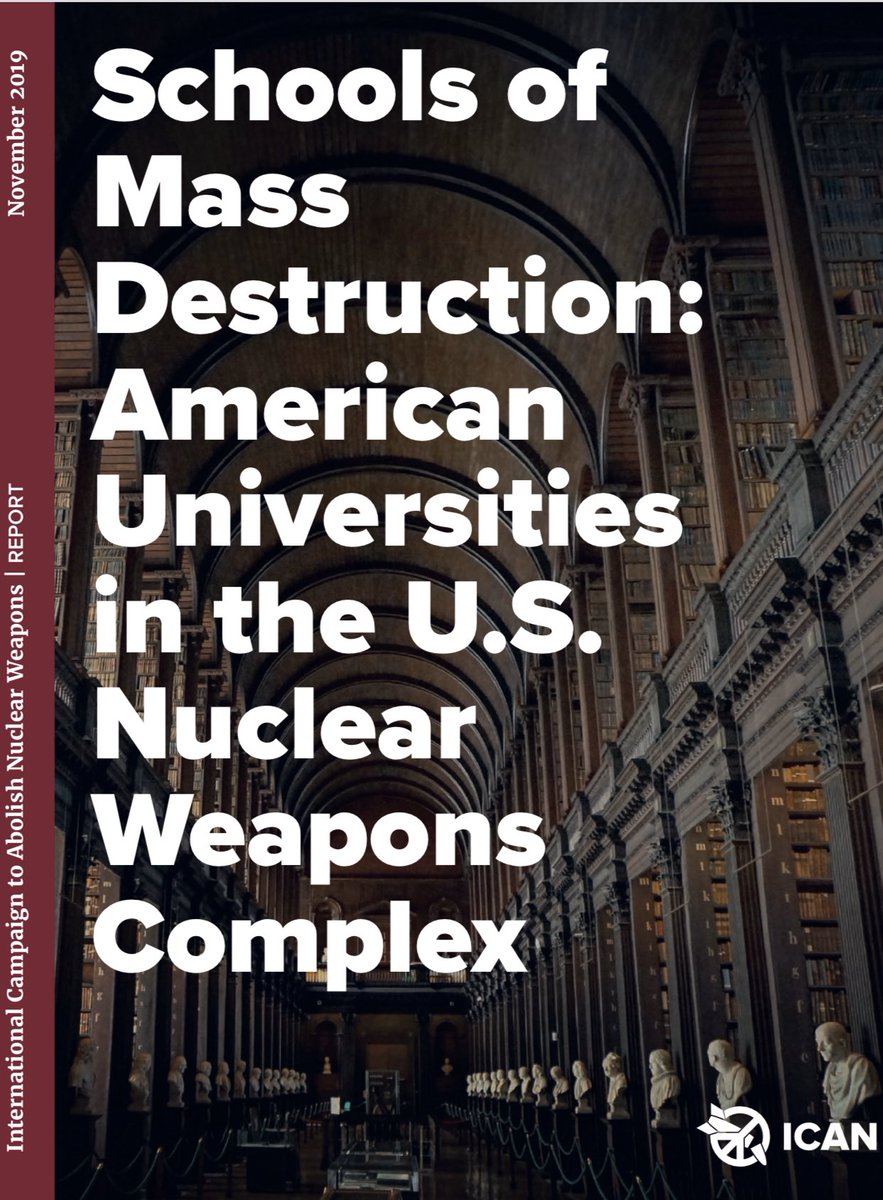
Schools of Mass Destruction: American Universities in the U.S. Nuclear Weapons Complex

Resultado de imagem para PICTURE OF sCHOOLS OF mASS dESTRUCTION ICAN

University of California

Nearly 50 U.S. universities are involved in the research and design of U.S. nuclear weapons, largely in secret and in contradiction of their mission statements. Students and faculty must demand their universities stop helping to build weapons of mass destruction.

The University of California has been involved in the management of the Los Alamos National Laboratory and the Lawrence Livermore National Laboratory - two of the nation’s primary nuclear weapons labs - since their inception. Multiple UC campuses have research partnerships with facilities in the nuclear weapons complex.

The state of California supports a complete ban on nuclear weapons; it is time for its university system to do the same.


More details about the University of California’s involvement

Currently, at a system level, the University of California is a partner in Triad National Security, LLC, along with Texas A&M University and Battelle Memorial Institute. Triad won the contract to operate the Los Alamos National Laboratory in 2018. The lab provides design and engineering for several nuclear warhead types, conducts simulated experiments to evaluate warheads, and has the capacity to produce plutonium pits, the core material for nuclear warheads. Department of Energy funding for the Lab in FY2019 was $2.48 billion, of which 76% comes from the NNSA’s Weapons Activities Appropriations.

The fixed fee awarded to Triad for executing the contract is about $20 million per year, with an additional $25-30 million available through award fees should it meet certain performance benchmarks. This is the money Triad receives above the costs of operating the facility. The University of California estimated that it would receive $8.9 million in net fee revenue from Triad for FY2019, which it plans to reinvest in lab oversight functions and funding for research partnerships between UC campuses and the labs.

In 2007, the management of Lawrence Livermore National Laboratory was awarded to a University of California-led LLC called Lawrence Livermore National Security, LLC. The partners in this LLC are the University of California, Bechtel National, BWX Technologies, and AECOM.

Similar to the Los Alamos lab, the Lawrence Livermore lab provides design and engineering for several nuclear warhead types and conducts simulated experiments to evaluate warheads. Department of Energy funding for the Lab in FY2019 was $1.56 billion, of which 86% comes from the NNSA’s Weapons Activities Appropriations.

The management organization is scheduled to receive a fixed fee of nearly $13 million in FY2019, with performance incentive fees of up to $30 million also available. It is unclear exactly how the partners in the LLC divide the fees. The University of California estimated that it would receive $13.6 million in net fee revenue from this lab for FY2019, which it would reinvest in lab oversight functions and funding for research partnerships between UC campuses and the labs.

Several individual campuses in the University of California system are listed as partners on the Lawrence Livermore National Laboratory website. When asked for more information, the responses from these campuses have shown varied levels of partnership, mostly at the level of research collaborations between faculty and the lab in different scientific areas.

Three campuses - UC Berkeley, UC Davis and UCLA - are partners in Sandia National Laboratories’ Campus Executive Program. This program aims to build deeper relational connections between the laboratory and different universities for the purpose of research collaboration and future workforce recruitment. In FY2018, Sandia invested $18.7 million in research across its Campus Executive and Academic Alliance universities. Sandia National Laboratories focuses on the non-nuclear components of nuclear weapons and on nuclear weapons systems integration, for example connecting warheads to their missile delivery systems. Sandia also performs simulated experiments to test the safety and reliability of nuclear weapons.

UC San Diego was awarded funding in 2018 for a Stewardship Science Academic Alliance Center of Excellence. The Center for Matter under Extreme Conditions will receive $10.5 million in research grants over five years. While the Stewardship Science Academic Alliance program funds basic, unclassified research, it seeks and funds proposals that have relevance to the stewardship of the nation’s nuclear stockpile.

For more information, including references, you can read the full report.


Texas A&M University

ICAN -- These 50 universities help build U.S. nuclear weapons

ICAN -- These 50 universities help build U.S. nuclear weapons


Universities are meant to teach students how to make the world better, not how to destroy it. But in our new report “Schools of Mass Destruction: American Universities in the U.S. Nuclear Weapons Complex,” we’re exposing nearly 50 U.S. universities that take billions of dollars in research funding to support U.S. nuclear weapons development.
View the full list of universities
The universities in this report are complicit in the new nuclear arms race. They provide the scientific, technical and human capital needed to build U.S. nuclear weapons. And they do so largely in secret: many staff and students of these universities are unaware of their institution’s involvement.
That’s why we’re releasing this report today. Students, staff and alumni of these universities must demand that their schools live up to their mission statements to improve the world, instead of working on the creation and maintenance of weapons designed to wipe out entire cities in a heartbeat, leaving lasting catastrophic humanitarian and environmental consequences.
We’re calling on all these universities to follow our recommendations to end their involvement with the U.S. nuclear weapons complex. Will you help us hold them accountable?
Ask these universities about their involvement on social media


Nearly 50 U.S. universities are involved in the research and design of U.S. nuclear weapons, largely in secret and in contradiction of their mission statements. Students and faculty must demand their universities stop helping to build weapons of mass destruction.

  1. Aiken Technical College
  2. Amarillo College
  3. Augusta Technical College
  4. Augusta University
  5. California Institute of Technology
  6. Carnegie Mellon University
  7. Cornell University
  8. George Washington University
  9. Georgetown University
  10. Georgia Institute of Technology
  11. Johns Hopkins University
  12. Kansas State University
  13. Massachusetts Institute of Technology
  14. Metropolitan Community College
  15. Missouri University
  16. New Mexico Institute of Mining and Technology
  17. New Mexico State University
  18. Northern New Mexico College
  19. Pittsburg State University
  20. Purdue University
  21. Roane State Community College
  22. Stanford University
  23. Texas A&M University
  24. Texas Tech University
  25. University of Arizona
  26. University of Arkansas
  27. University of California
  28. University of California - Berkeley
  29. University of California - Davis
  30. University of California - Los Angeles
  31. University of California - San Diego
  32. University of Colorado - Boulder
  33. University of Florida
  34. University of Illinois at Urbana-Champaign
  35. University of Kansas
  36. University of Michigan
  37. University of Missouri - Kansas City
  38. University of Nebraska
  39. University of Nevada - Las Vegas
  40. University of Nevada - Reno
  41. University of New Mexico
  42. University of Notre Dame
  43. University of Rochester
  44. University of South Carolina - Aiken
  45. University of South Carolina - Salkehatchie
  46. University of Tennessee
  47. University of Texas at Austin
  48. University of Utah
  49. University of Wisconsin - Madison

Types of involvement by university:

Friday, September 27, 2019

International Day for the Total Elimination of Nuclear Weapons: ICAN statements at United Nations

3

International Day for the Total Elimination of Nuclear Weapons: ICAN statements at United Nations

September 26, 2019
For other events taking place in New York and around the world to mark the International Day for the Total Elimination of Nuclear Weapons, follow the live-blog.

ICAN statement to the High-Level Plenary Meeting to commemorate and Promote the International Day for the Total Elimination of Nuclear Weapons
During the UNGA event to mark the International Day for the Total Elimination of Nuclear Weapons, Campaigner Mitchie Takeuchi, second-generation Hibakusha and granddaughter to the director of the Red Cross hospital in Hiroshima at the time of the bombing, delivered the following statement on behalf of the International Campaign to Abolish Nuclear weapons:
Mr. President, distinguished delegates, and colleagues,
My name is Mitchie Takeuchi. I have the honour today to represent the International Campaign to Abolish Nuclear Weapons, the 2017 Nobel Peace Laureate. I grew up in Hiroshima and my family survived the atomic bombing in 1945. I wish to share something of my own story and the importance of ICAN’s collective work around the world to usher in an age of the end of nuclear weapons.
In 1938, my grandfather, Ken Takeuchi, became the founding president of the Red Cross Hospital in Hiroshima. On August 6th he and most of his colleagues arrived a little before 8 a.m., which meant they were inside the hospital building before the first war-time use of an atomic bomb levelled my hometown. My grandfather’s request that they come early saved many doctor’s lives, so they could save more civilians that day. Although close to Ground Zero, the Red Cross Hospital withstood total destruction.
My grandfather remembers an enormous blast that caused a heavy door to fly off its hinges and knock him unconscious. When he came to, he was not able to move due to broken bones all over his body. His face also sustained horrible injuries. He had been carried to the outside of the main hospital building. What he saw defies description—unimaginable suffering, wailing and crying, dead bodies everywhere. It was complete chaos.

Thursday, May 2, 2019

ICAN -- These 28 companies are making nuclear weapons

Dear Friend,

Today the ICAN partner organization PAX is releasing new research that shows which 28 private companies are involved in building nuclear weapons. 
Click here to see which companies you need to avoid
The research shows that these companies are fuelling a new nuclear arms race and putting the world in danger and should be blacklisted by any responsible bank and financial institution. 

Read the full report here. 
Susi Snyder, Author, Don't Bank on the Bomb. 
International Campaign to Abolish Nuclear Weapons

Monday, August 6, 2018

Hiroshima and Nagasaki: 7 things you should know

6030967551_d64dbbd7b3_z


Hiroshima and Nagasaki: 7 things you should know

August 3, 2018
Next week marks 73 years since two atomic bombs were dropped over the cities of Hiroshima and Nagasaki. Hundreds of thousands of people were killed and maimed, and the effects are still being felt today. But while the mushroom clouds became iconic symbols of mass destruction, and the paper cranes a symbol of hope for a nuclear-free world, there are many things you may not know – or may have forgotten – that are really important if we’re going to make sure this never happens again.

#1 More than 210,000 people were killed

By the end of 1945, the bombing had killed an estimated 140,000 people in Hiroshima, and a further 74,000 in Nagasaki. In the years that followed, many of the survivors would face leukemia, cancer, or other terrible side effects from the radiation.
“Each person had a name. Each person was loved by someone. Let us ensure that their deaths were not in vain.”
- Setsuko Thurlow, survivor of the August 1945 atomic bombing of Hiroshima
Nobel Peace Prize acceptance speech, December 2017


#2 The bombs were detonated in the air

Bombs don’t have to hit the ground in order to detonate. For nuclear weapons, detonating them in the air causes the blast to have a larger geographical impact. Both “Little Boy” (the uranium bomb dropped on Hiroshima) and “Fat Man” (the plutonium bomb dropped on Nagasaki) were detonated in the air. You can find out more about what impact a detonation on the air or on the ground would have on your city through the Outrider Foundation’s powerful (but terrifying) interactive tool:
Blast Radius of the Hiroshima Blast

#3 First responders couldn’t help back then, and they wouldn’t be able to help now.

If a nuclear weapon were to be detonated over a city today, first responders – hospitals, firemen, aid organisations – would simply be unable to help. This powerful video by the Red Cross explains why:

Manifestações

2007 Speech

UKRAINE ON FIRE

Discurso do Presidente da Rússia, Vladimir Putin, na manhã do dia 24 de Fevereiro de 2022

Discurso do Presidente da Rússia, Vladimir Putin, Tradução em português


Presidente da Rússia, Vladimir Putin: Cidadãos da Rússia, Amigos,

Considero ser necessário falar hoje, de novo, sobre os trágicos acontecimentos em Donbass e sobre os aspectos mais importantes de garantir a segurança da Rússia.

Começarei com o que disse no meu discurso de 21 de Fevereiro de 2022. Falei sobre as nossas maiores responsabilidades e preocupações e sobre as ameaças fundamentais que os irresponsáveis políticos ocidentais criaram à Rússia de forma continuada, com rudeza e sem cerimónias, de ano para ano. Refiro-me à expansão da NATO para Leste, que está a aproximar cada vez mais as suas infraestruturas militares da fronteira russa.

É um facto que, durante os últimos 30 anos, temos tentado pacientemente chegar a um acordo com os principais países NATO, relativamente aos princípios de uma segurança igual e indivisível, na Europa. Em resposta às nossas propostas, enfrentámos invariavelmente, ou engano cínico e mentiras, ou tentativas de pressão e de chantagem, enquanto a aliança do Atlântico Norte continuou a expandir-se, apesar dos nossos protestos e preocupações. A sua máquina militar está em movimento e, como disse, aproxima-se da nossa fronteira.

Porque é que isto está a acontecer? De onde veio esta forma insolente de falar que atinge o máximo do seu excepcionalismo, infalibilidade e permissividade? Qual é a explicação para esta atitude de desprezo e desdém pelos nossos interesses e exigências absolutamente legítimas?

Read more

ARRIVING IN CHINA

Ver a imagem de origem

APPEAL


APPEAL TO THE LEADERS OF THE NINE NUCLEAR WEAPONS' STATES

(China, France, India, Israel, North Korea, Pakistan, Russia, the United Kingdom and the United States)

中文 DEUTSCH ENGLISH FRANÇAIS ITALIAN PORTUGUESE RUSSIAN SPANISH ROMÂNA

manlio + maria

MOON OF SHANGHAI site

LR on CORONAVIRUS

LARRY ROMANOFF on CORONAVIRUS

Read more at Moon of Shanghai

World Intellectual Property Day (or Happy Birthday WIPO) - Spruson ...


Moon of Shanghai

L Romanoff

Larry Romanoff,

contributing author

to Cynthia McKinney's new COVID-19 anthology

'When China Sneezes'

When China Sneezes: From the Coronavirus Lockdown to the Global Politico-Economic Crisis

manlio

James Bacque

BYOBLU

irmãos de armas


Subtitled in PT, RO, SP

Click upon CC and choose your language.


manlio

VP


Before the Presidential Address to the Federal Assembly.


The President of Russia delivered
the Address to the Federal Assembly. The ceremony took
place at the Manezh Central Exhibition Hall.


January
15, 2020


vp

President of Russia Vladimir Putin:

Address to the Nation

Address to the Nation.

READ HERE


brics


Imagem

PT -- VLADIMIR PUTIN na Sessão plenária do Fórum Económico Oriental

Excertos da transcrição da sessão plenária do Fórum Económico Oriental

THE PUTIN INTERVIEWS


The Putin Interviews
by Oliver Stone (
FULL VIDEOS) EN/RU/SP/FR/IT/CH


http://tributetoapresident.blogspot.com/2018/07/the-putin-interviews-by-oliver-stone.html


TRIBUTE TO A PRESIDENT


NA PRMEIRA PESSOA

Um auto retrato surpreendentemente sincero do Presidente da Rússia, Vladimir Putin

CONTEÚDO

Prefácio

Personagens Principais em 'Na Primeira Pessoa'

Parte Um: O Filho

Parte Dois: O Estudante

Parte Três: O Estudante Universitário

Parte Quatro: O Jovem especialista

Parte Cinco: O Espia

Parte Seis: O Democrata

Parte Sete: O Burocrata

Parte Oito: O Homem de Família

Parte Nove: O Político

Apêndice: A Rússia na Viragem do Milénio


contaminação nos Açores


Subtitled in EN/PT

Click upon the small wheel at the right side of the video and choose your language.


convegno firenze 2019