GIULIETTO CHIESA

FREE JULIAN ASSANGE

WWIII + S SITE


CROATIAN   ENGLISH   GREEK   NEDERLANDS   POLSKI   PORTUGUESE   ROMANIAN  SPANISH  РУССКИЙ

What part will your country play in World War III?

By Larry Romanoff

The true origins of the two World Wars have been deleted from all our history books and replaced with mythology. Neither War was started (or desired) by Germany, but both at the instigation of a group of European Zionist Jews with the stated intent of the total destruction of Germany. The documentation is overwhelming and the evidence undeniable. (1) (2) (3) (4) (5) (6) (7) (8) (9) (10) (11)

That history is being repeated today in a mass grooming of the Western world’s people (especially Americans) in preparation for World War IIIwhich I believe is now imminent

READ MORE


Showing posts with label NUCLEAR WAR. Show all posts

Friday, April 29, 2022

Eric Zuesse -- UK/U.S. Regime Now Goes for the Kill Against Both Russia & China


UK/U.S. Regime Now Goes for the Kill Against Both Russia & China


Is ‘Nuclear Primacy’ likely to be reached soon?


Eric Zuesse, April 29, 2022 


What follows after this opening article by Russia’s RT will place it into historical context:


——

https://www.rt.com/news/554646-liz-truss-nato-ukraine-taiwan/

https://archive.ph/jGCBL

28 April 2022 01:03

“UK calls for a ‘global NATO’”

Saturday, January 25, 2020

Closer than Ever: It Is 100 Seconds to Midnight. The Dangers of Nuclear War

To: Leaders and citizens of the world
Humanity continues to face two simultaneous existential dangers—nuclear war and climate change—that are compounded by a threat multiplier, cyber-enabled information warfare, that undercuts society’s ability to respond. The international security situation is dire, not just because these threats exist, but because world leaders have allowed the international political infrastructure for managing them to erode.
In the nuclear realm, national leaders have ended or undermined several major arms control treaties and negotiations during the last year, creating an environment conducive to a renewed nuclear arms race, to the proliferation of nuclear weapons, and to lowered barriers to nuclear war. Political conflicts regarding nuclear programs in Iran and North Korea remain unresolved and are, if anything, worsening. US-Russia cooperation on arms control and disarmament is all but nonexistent.
Public awareness of the climate crisis grew over the course of 2019, largely because of mass protests by young people around the world. Just the same, governmental action on climate change still falls far short of meeting the challenge at hand. At UN climate meetings last year, national delegates made fine speeches but put forward few concrete plans to further limit the carbon dioxide emissions that are disrupting Earth’s climate. This limited political response came during a year when the effects of manmade climate change were manifested by one of the warmest years on record, extensive wildfires, and quicker-than-expected melting of glacial ice.
Continued corruption of the information ecosphere on which democracy and public decision making depend has heightened the nuclear and climate threats. In the last year, many governments used cyber-enabled disinformation campaigns to sow distrust in institutions and among nations, undermining domestic and international efforts to foster peace and protect the planet.
This situation—two major threats to human civilization, amplified by sophisticated, technology-propelled propaganda—would be serious enough if leaders around the world were focused on managing the danger and reducing the risk of catastrophe. Instead, over the last two years, we have seen influential leaders denigrate and discard the most effective methods for addressing complex threats—international agreements with strong verification regimes—in favor of their own narrow interests and domestic political gain. By undermining cooperative, science- and law-based approaches to managing the most urgent threats to humanity, these leaders have helped to create a situation that will, if unaddressed, lead to catastrophe, sooner rather than later.

Sunday, December 8, 2019

David Swanson -- West Point Professor Builds a Case Against the U.S. Army


By David Swanson, World BEYOND War, December 7, 2019
West Point Professor Tim Bakken’s new book The Cost of Loyalty: Dishonesty, Hubris, and Failure in the U.S. Military traces a path of corruption, barbarism, violence, and unaccountability that makes its way from the United States’ military academies (West Point, Annapolis, Colorado Springs) to the top ranks of the U.S. military and U.S. governmental policy, and from there into a broader U.S. culture that, in turn, supports the subculture of the military and its leaders.
The U.S. Congress and presidents have ceded tremendous power to generals. The State Department and even the U.S. Institute of Peace are subservient to the military. The corporate media and the public help maintain this arrangement with their eagerness to denounce anyone who opposes the generals. Even opposing giving free weapons to Ukraine is now quasi-treasonous.
Within the military, virtually everyone has ceded power to those of higher rank. Disagreeing with them is likely to end your career, a fact that helps explain why so many military officials say what they really think about the current wars just after retiring.
But why does the public go along with out of control militarism? Why are so few speaking out and raising hell against wars that only 16% of the public tell pollsters they support? Well, the Pentagon spent $4.7 billion in 2009, and likely more in each year since, on propaganda and public relations. Sports leagues are paid with public dollars to stage “rituals that are akin to worship,” as Bakken appropriately describes the fly-overs, weapons shows, troop honorings, and war hymn screechings that precede professional athletics events. The peace movement has far superior materials but comes up a little short of $4.7 billion each year for advertising.
Speaking out against war can get you attacked as unpatriotic or “a Russian asset,” which helps explain why environmentalists don’t mention one of the worst polluters, refugee aid groups don’t mention the primary cause of the problem, activists trying to end mass-shootings never mention that the shooters are disproportionately veterans, anti-racist groups avoid noticing the way militarism spreads racism, plans for green new deals or free college or healthcare usually manage not to mention the place where most of the money is now, etc. Overcoming this hurdle is the work being taken on by World BEYOND War.

Saturday, December 7, 2019

Cyber Battles, Nuclear Outcomes? Dangerous New Pathways to Escalation


Cyber Battles, Nuclear Outcomes? 
Dangerous New Pathways to Escalation


November 2019
By Michael T. Klare
In January 2018, details of the Trump administration’s Nuclear Posture Review (NPR) were posted online by the Huffington Post, provoking widespread alarm over what were viewed as dangerous shifts in U.S. nuclear policy. Arousing most concern was a call for the acquisition of several types of low-yield nuclear weapons, a proposal viewed by many analysts as increasing the risk of nuclear weapons use.
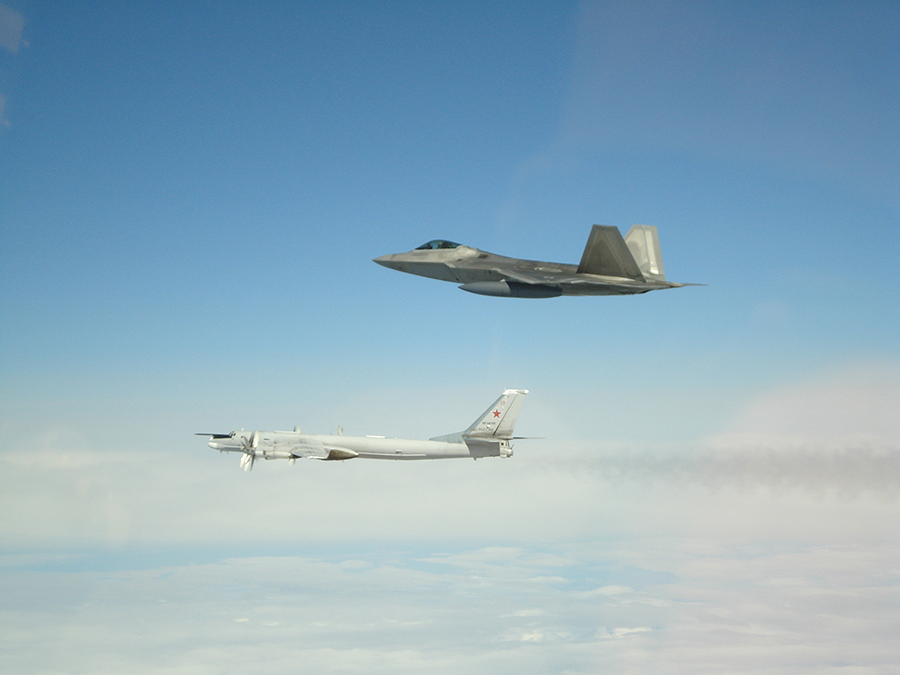
A U.S. F-22 fighter shadows a Russian Tu-95 bomber on May 20 in international airspace near Alaska. Aircraft and missile detection systems rely heavily on electronic communications, making them potential targets for cyberwarfare. (Photo: NORAD)
Another initiative incorporated in the strategy document also aroused concern: the claim that an enemy cyberattack on U.S. nuclear command, control, and communications (NC3) facilities would constitute a “non-nuclear strategic attack” of sufficient magnitude to justify the use of nuclear weapons in response.
Under the Obama administration’s NPR report, released in April 2010, the circumstances under which the United States would consider responding to non-nuclear attacks with nuclear weapons were said to be few. “The United States will continue to…reduce the role of nuclear weapons in deterring non-nuclear attacks,” the report stated. Although little was said about what sort of non-nuclear attacks might be deemed severe enough to justify a nuclear response, cyberstrikes were not identified as one of these. The 2018 NPR report, however, portrayed a very different environment, one in which nuclear combat is seen as increasingly possible and in which non-nuclear strategic threats, especially in cyberspace, were viewed as sufficiently menacing to justify a nuclear response. Speaking of Russian technological progress, for example, the draft version of the Trump administration’s NPR report stated, “To…correct any Russian misperceptions of advantage, the president will have an expanding range of limited and graduated [nuclear] options to credibly deter Russian nuclear or non-nuclear strategic attacks, which could now include attacks against U.S. NC3, in space and cyberspace.”1
The notion that a cyberattack on U.S. digital systems, even those used for nuclear weapons, would constitute sufficient grounds to launch a nuclear attack was seen by many observers as a dangerous shift in policy, greatly increasing the risk of accidental or inadvertent nuclear escalation in a crisis. “The entire broadening of the landscape for nuclear deterrence is a very fundamental step in the wrong direction,” said former Secretary of Energy Ernest Moniz. “I think the idea of nuclear deterrence of cyberattacks, broadly, certainly does not make any sense.”2

Wednesday, November 27, 2019

The Real Reason America Used Nuclear Weapons Against Japan. It Was Not To End the War Or Save Lives.

The Real Reason America Used Nuclear Weapons Against Japan. It Was Not To End the War Or Save Lives.

Region: 
In-depth Report: 
Relevant article selected from the GR archive, first published on Washington Blog and Global Research in October 2012.
Atomic Weapons Were Not Needed to End the War or Save Lives
Like all Americans, I was taught that the U.S. dropped nuclear bombs on Hiroshima and Nagasaki in order to end WWII and save both American and Japanese lives.
But most of the top American military officials at the time said otherwise.
The U.S. Strategic Bombing Survey group, assigned by President Truman to study the air attacks on Japan, produced a report in July of 1946 that concluded (52-56):
Based on a detailed investigation of all the facts and supported by the testimony of the surviving Japanese leaders involved, it is the Survey’s opinion that certainly prior to 31 December 1945 and in all probability prior to 1 November 1945, Japan would have surrendered even if the atomic bombs had not been dropped, even if Russia had not entered the war, and even if no invasion had been planned or contemplated.
General (and later president) Dwight Eisenhower – then Supreme Commander of all Allied Forces, and the officer who created most of America’s WWII military plans for Europe and Japan – said:
The Japanese were ready to surrender and it wasn’t necessary to hit them with that awful thing.
Newsweek, 11/11/63, Ike on Ike
Eisenhower also noted (pg. 380):
In [July] 1945… Secretary of War Stimson, visiting my headquarters in Germany, informed me that our government was preparing to drop an atomic bomb on Japan. I was one of those who felt that there were a number of cogent reasons to question the wisdom of such an act. …the Secretary, upon giving me the news of the successful bomb test in New Mexico, and of the plan for using it, asked for my reaction, apparently expecting a vigorous assent.
During his recitation of the relevant facts, I had been conscious of a feeling of depression and so I voiced to him my grave misgivings, first on the basis of my belief that Japan was already defeated and that dropping the bomb was completely unnecessary, and secondly because I thought that our country should avoid shocking world opinion by the use of a weapon whose employment was, I thought, no longer mandatory as a measure to save American lives. It was my belief that Japan was, at that very moment, seeking some way to surrender with a minimum loss of ‘face’. The Secretary was deeply perturbed by my attitude….
Admiral William Leahy – the highest ranking member of the U.S. military from 1942 until retiring in 1949, who was the first de facto Chairman of the Joint Chiefs of Staff, and who was at the center of all major American military decisions in World War II – wrote (pg. 441):
It is my opinion that the use of this barbarous weapon at Hiroshima and Nagasaki was of no material assistance in our war against Japan. The Japanese were already defeated and ready to surrender because of the effective sea blockade and the successful bombing with conventional weapons.
The lethal possibilities of atomic warfare in the future are frightening. My own feeling was that in being the first to use it, we had adopted an ethical standard common to the barbarians of the Dark Ages. I was not taught to make war in that fashion, and wars cannot be won by destroying women and children.
General Douglas MacArthur agreed (pg. 65, 70-71):
MacArthur’s views about the decision to drop the atomic bomb on Hiroshima and Nagasaki were starkly different from what the general public supposed …. When I asked General MacArthur about the decision to drop the bomb, I was surprised to learn he had not even been consulted. What, I asked, would his advice have been? He replied that he saw no military justification for the dropping of the bomb. The war might have ended weeks earlier, he said, if the United States had agreed, as it later did anyway, to the retention of the institution of the emperor.

Monday, November 25, 2019

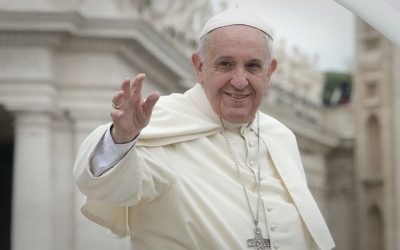
Popes Against Nuclear Weapons

Popes Against Nuclear Weapons

Region: 
In-depth Report: 

The Vatican comes with its ills, contradictions and blatant hypocrisies in the field of moral theology and human existence, but on the issue of atomic and nuclear weapons, the position has been fairly consistent, if marked by gradual evolution.  On February 8, 1948, Pope Pius XII held an audience with members of the Pontifical Academy of Sciences.  “What misfortunes,” he asked, “should humanity expect from a future conflict, if it should prove impossible to arrest or curb the use of ever newer and more surprising scientific inventions?”
The Second Vatican Council through its 1965 document Gaudium et spes deemed the arms race “one of the greatest curses on humanity and the harm it inflicts on the poor is more than can be endured”.  Using nuclear weapons exceeded “the limits of legitimate self-defence”, and would constitute a “crime against God and against humanity itself.  It merits unequivocal and unhesitating condemnation.”  Pope Paul VI would subsequently give his approval to the Nuclear Arms Non-Proliferation Treaty, making nuclear disarmament a matter of highest moral urgency.
But attitudes to nuclear weapons were always chained to the Cold War orbit and the old dilemmas of self-defence.  In November 1980, with the election of US President Ronald Reagan, Auxiliary Bishop Thomas Gumbleton of Detroit expressed genuine terror at the prospect of a pro-bomb enthusiast in the White House.

Wednesday, November 6, 2019

Ukraine joining NATO would take world dangerously close to nuclear war


Ukraine joining NATO would take world dangerously close to nuclear war
George Galloway
George Galloway was a member of the British Parliament for nearly 30 years. He presents TV and radio shows (including on RT). He is a film-maker, writer and a renowned orator.
6 Nov, 2019 14:33 / Updated 1 hour ago
Ukraine joining NATO would take world dangerously close to nuclear war
©  Getty Images / STR / NurPhoto
Ukrainian membership of NATO would be a brazen provocation that could finally break the back of Moscow’s patience. Besides, very few seem to worry about the ontology of Ukrainian nationalism.
The Berlin Wall fell 30 years ago and with it eventually the “Iron Curtain” which had divided Europe from Stettin in the Baltic to Trieste in the Adriatic.
Russia accepted this on the basis of a clear assurance from the US that NATO would not expand its frontline any closer to Russia’s borders. A promise that wasn’t worth the paper it wasn’t written on.
That much is demonstrated daily by the presence of US missiles in Poland and Romania, periodic war-games which are clearly predicated on possible war with Russia, and now with the renewed “offer” to the Ukraine of membership of the NATO war alliance.
It is obviously true that some at least are nervous about the Ukraine finally joining NATO. They worry it might be that straw that finally breaks the back of Russia’s patience. They worry about Ukraine’s stability. The country has had governments friendly to Russia relatively recently and might do so again. They compare it to Turkey and worry about whether the new president of Ukraine can really be guaranteed to stay in power and moreover stay loyal to the anti-Russian cause. 
And some, at least one hopes, worry about the ontology of Ukrainian nationalism. In the week in which the German city of Dresden declared a “Nazi emergency,” so worried are the authorities about a far-right insurgency, the merest glance at the right of Ukrainian politics is enough to chill the blood.

Friday, October 18, 2019

U.S.-Russian Nuclear Arms Control Watch, Oct. 17, 2019

U.S.-Russian Nuclear Arms Control Watch, Oct. 17, 2019
2018 Estimated global nuclear warhead inventories (updated June 20, 2018). https://www.armscontrol.org/factsheets/Nuclearweaponswhohaswhat. Reprinted with permission from The Arms Control Association.


Share this

ARMS CONTROL NOW

Authored by Kingston Reif and Shannon Bugos on October 17, 2019


Trump Poised to Withdraw from Open Skies Treaty

The Trump administration is reportedly on the verge of withdrawing from the 1992 Open Skies Treaty, according to lawmakers and media reports. Rep. Eliot Engel (D-N.Y.), chairman of the House Foreign Affairs Committee, first sounded the public alarm in an Oct. 7 letter to National Security Advisor Robert C. O’Brien.
“I am deeply concerned by reports that the Trump Administration is considering withdrawing from the Open Skies Treaty and strongly urge you against such a reckless action,” Rep. Engel wrote. “American withdrawal would only benefit Russia and be harmful to our allies’ and partners’ national security interests.”
Slate columnist Fred Kaplan reported Oct. 9 that former National Security Advisor John Bolton pushed for withdrawing from the treaty before departing the administration. Following Bolton’s departure in September, White House staff continued to advocate for withdrawal and convinced President Trump to sign a memorandum expressing his intent to exit the treaty. The Omaha World-Herald reported that the signed document directed a withdrawal by Oct. 26.
House Armed Services Committee Chairman Rep. Adam Smith (D-Wash.), Senate Foreign Relations Committee Ranking Member Sen. Bob Menendez (D-N.J.), and Senate Armed Services Committee Ranking Member Jack Reed (D-R.I.) joined Rep. Engel in an Oct. 8 letter to Secretary of State Mike Pompeo and Secretary of Defense Mark Esper denouncing a possible withdrawal. The lawmakers wrote that “pulling out of the Open Skies Treaty, an important multilateral arms control agreement, would be yet another gift from the Trump Administration to Putin.” They also noted that the treaty “has been an essential tool for United States efforts to constrain Russian aggression in Ukraine.”
The United States and several allies in December 2018 conducted an “extraordinary flight” over eastern Ukraine under the Open Skies Treaty. The flight followed a Russian attack in late November 2018 on Ukrainian naval vessels in the Black Sea.
Republican lawmakers also expressed concern about ditching the treaty. In an Oct. 8 statement, Rep. Don Bacon (R-Neb.) stated that he has “yet to see a compelling reason to withdraw from Open Skies” given the “valuable access to Russian airspace and military airfields” the United States gains from the treaty.
Signed in 1992, the Open Skies Treaty permits each state-party to conduct short-notice, unarmed, observation flights over the others’ entire territories in order to collect data on military forces and activities. The treaty entered into force in January 2002 and currently has 34 states-parties, including the United States and Russia.

Tuesday, October 15, 2019

Daniel Ellsberg on the creation of nuclear doomsday machines, the institutional insanity that maintains them, and a practical plan for dismantling them.

Resultado de imagem para PICTURES OF dANIEL ELLSBERG AT 80.000 HOURS


By Robert Wiblin and Keiran Harris · Published September 24th, 2018
Contents


Share on Twitter

Share on Facebook

Share on Linked In

Close
The 80,000 Hours Podcast with Robert Wiblin         
#43 - Daniel Ellsberg on the creation of nuclear doomsday machines, the institutional insanity that maintains them, and a practical plan for dismantling them.           #43 - Daniel Ellsberg on the creation of nuclear doomsday machines, the institutional insanity that maintains them, and a practical plan for dismantling them.          


The 80,000 Hours Podcast with Robert Wiblin         
#43 - Daniel Ellsberg on the creation of nuclear doomsday machines, the institutional insanity that maintains them, and a practical plan for dismantling them.           #43 - Daniel Ellsberg on the creation of nuclear doomsday machines, the institutional insanity that maintains them, and a practical plan for dismantling them.          
Enjoyed the episode? Want to listen later? Subscribe by searching 80,000 Hours wherever you get your podcasts, or click one of the buttons below:

We are on the Titanic, going at full speed on a moonless night into iceberg waters. Have we hit the iceberg yet, and made it inevitable that we will go down? We don’t know. …. there’s no way to prove it. It is definitely not a waste for some of us to keep trying to explore to see if there’s a way out.
Daniel Ellsberg
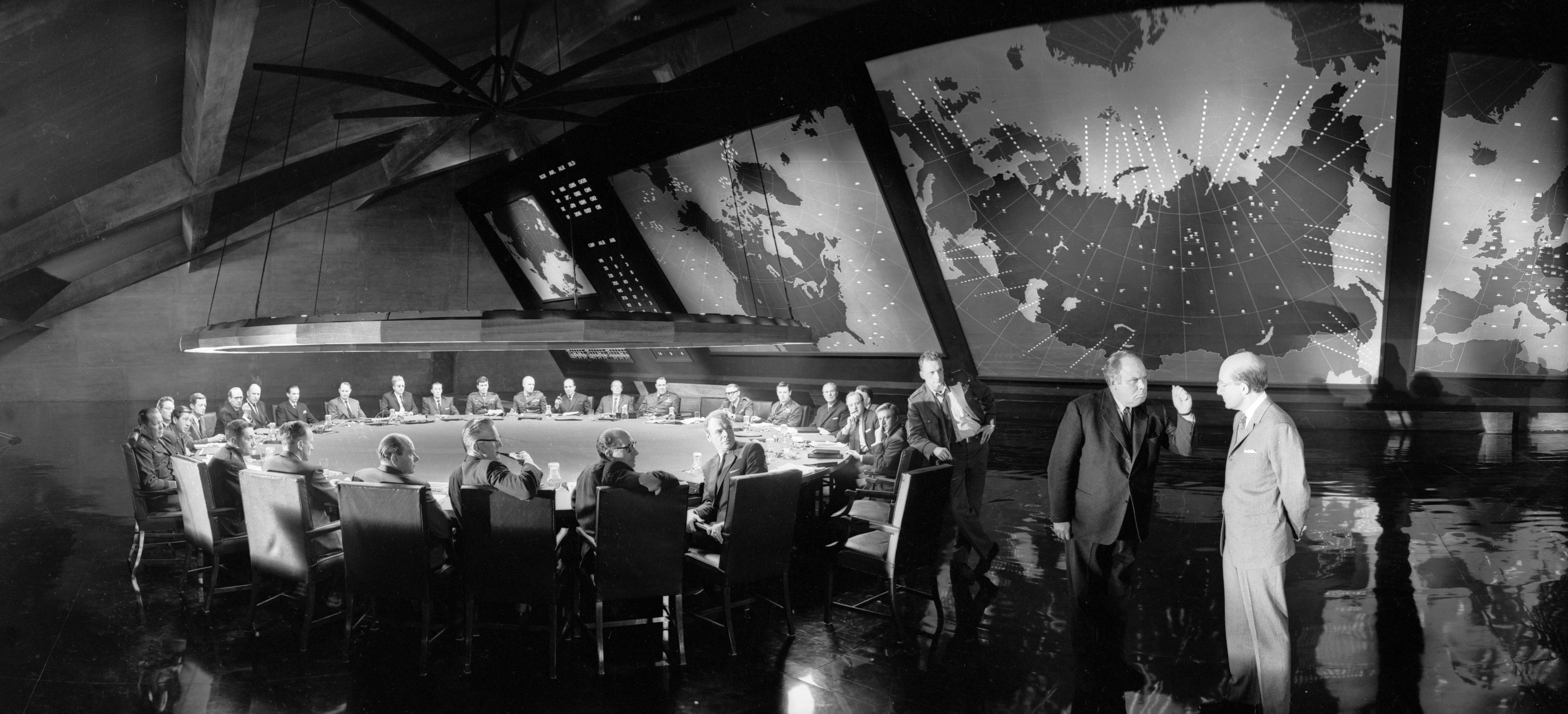
In Stanley Kubrick’s iconic film Dr. Strangelove, the American president is informed that the Soviet Union has created a secret deterrence system which will automatically wipe out humanity upon detection of a single nuclear explosion in Russia. With US bombs heading towards the USSR and unable to be recalled, Dr Strangelove points out that “the whole point of this Doomsday Machine is lost if you keep it a secret – why didn’t you tell the world, eh?” The Soviet ambassador replies that it was to be announced at the Party Congress the following Monday: “The Premier loves surprises”.
Daniel Ellsberg – leaker of the Pentagon Papers which helped end the Vietnam War and Nixon presidency – claims in his new book The Doomsday Machine: Confessions of a Nuclear War Planner that Dr. Strangelove might as well be a documentary. After attending the film in Washington DC in 1964, he and a military colleague wondered how so many details of the nuclear systems they were constructing had managed to leak to the filmmakers.

Manifestações

2007 Speech

UKRAINE ON FIRE

Discurso do Presidente da Rússia, Vladimir Putin, na manhã do dia 24 de Fevereiro de 2022

Discurso do Presidente da Rússia, Vladimir Putin, Tradução em português


Presidente da Rússia, Vladimir Putin: Cidadãos da Rússia, Amigos,

Considero ser necessário falar hoje, de novo, sobre os trágicos acontecimentos em Donbass e sobre os aspectos mais importantes de garantir a segurança da Rússia.

Começarei com o que disse no meu discurso de 21 de Fevereiro de 2022. Falei sobre as nossas maiores responsabilidades e preocupações e sobre as ameaças fundamentais que os irresponsáveis políticos ocidentais criaram à Rússia de forma continuada, com rudeza e sem cerimónias, de ano para ano. Refiro-me à expansão da NATO para Leste, que está a aproximar cada vez mais as suas infraestruturas militares da fronteira russa.

É um facto que, durante os últimos 30 anos, temos tentado pacientemente chegar a um acordo com os principais países NATO, relativamente aos princípios de uma segurança igual e indivisível, na Europa. Em resposta às nossas propostas, enfrentámos invariavelmente, ou engano cínico e mentiras, ou tentativas de pressão e de chantagem, enquanto a aliança do Atlântico Norte continuou a expandir-se, apesar dos nossos protestos e preocupações. A sua máquina militar está em movimento e, como disse, aproxima-se da nossa fronteira.

Porque é que isto está a acontecer? De onde veio esta forma insolente de falar que atinge o máximo do seu excepcionalismo, infalibilidade e permissividade? Qual é a explicação para esta atitude de desprezo e desdém pelos nossos interesses e exigências absolutamente legítimas?

Read more

ARRIVING IN CHINA

Ver a imagem de origem

APPEAL


APPEAL TO THE LEADERS OF THE NINE NUCLEAR WEAPONS' STATES

(China, France, India, Israel, North Korea, Pakistan, Russia, the United Kingdom and the United States)

中文 DEUTSCH ENGLISH FRANÇAIS ITALIAN PORTUGUESE RUSSIAN SPANISH ROMÂNA

manlio + maria

MOON OF SHANGHAI site

LR on CORONAVIRUS

LARRY ROMANOFF on CORONAVIRUS

Read more at Moon of Shanghai

World Intellectual Property Day (or Happy Birthday WIPO) - Spruson ...


Moon of Shanghai

L Romanoff

Larry Romanoff,

contributing author

to Cynthia McKinney's new COVID-19 anthology

'When China Sneezes'

When China Sneezes: From the Coronavirus Lockdown to the Global Politico-Economic Crisis

manlio

James Bacque

BYOBLU

irmãos de armas


Subtitled in PT, RO, SP

Click upon CC and choose your language.


manlio

VP


Before the Presidential Address to the Federal Assembly.


The President of Russia delivered
the Address to the Federal Assembly. The ceremony took
place at the Manezh Central Exhibition Hall.


January
15, 2020


vp

President of Russia Vladimir Putin:

Address to the Nation

Address to the Nation.

READ HERE


brics


Imagem

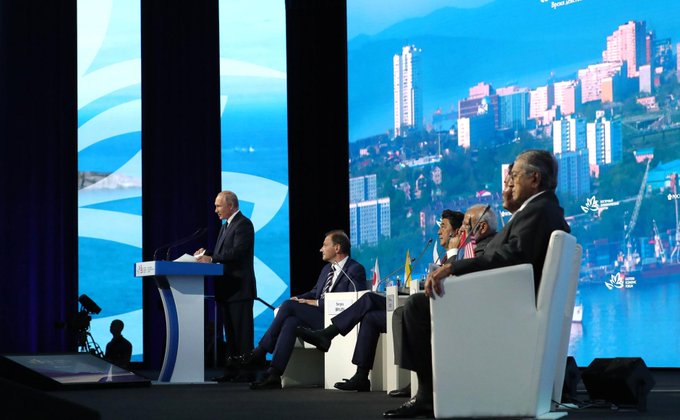
PT -- VLADIMIR PUTIN na Sessão plenária do Fórum Económico Oriental

Excertos da transcrição da sessão plenária do Fórum Económico Oriental

THE PUTIN INTERVIEWS


The Putin Interviews
by Oliver Stone (
FULL VIDEOS) EN/RU/SP/FR/IT/CH


http://tributetoapresident.blogspot.com/2018/07/the-putin-interviews-by-oliver-stone.html


TRIBUTE TO A PRESIDENT


NA PRMEIRA PESSOA

Um auto retrato surpreendentemente sincero do Presidente da Rússia, Vladimir Putin

CONTEÚDO

Prefácio

Personagens Principais em 'Na Primeira Pessoa'

Parte Um: O Filho

Parte Dois: O Estudante

Parte Três: O Estudante Universitário

Parte Quatro: O Jovem especialista

Parte Cinco: O Espia

Parte Seis: O Democrata

Parte Sete: O Burocrata

Parte Oito: O Homem de Família

Parte Nove: O Político

Apêndice: A Rússia na Viragem do Milénio


contaminação nos Açores


Subtitled in EN/PT

Click upon the small wheel at the right side of the video and choose your language.


convegno firenze 2019