GIULIETTO CHIESA

FREE JULIAN ASSANGE

WWIII + S SITE


CROATIAN   ENGLISH   GREEK   NEDERLANDS   POLSKI   PORTUGUESE   ROMANIAN  SPANISH  РУССКИЙ

What part will your country play in World War III?

By Larry Romanoff

The true origins of the two World Wars have been deleted from all our history books and replaced with mythology. Neither War was started (or desired) by Germany, but both at the instigation of a group of European Zionist Jews with the stated intent of the total destruction of Germany. The documentation is overwhelming and the evidence undeniable. (1) (2) (3) (4) (5) (6) (7) (8) (9) (10) (11)

That history is being repeated today in a mass grooming of the Western world’s people (especially Americans) in preparation for World War III – which I believe is now imminent. 

READ MORE


Showing posts with label John Bolton. Show all posts

Friday, November 22, 2019

‘Suppressed unfairly’? John Bolton’s Twitter comeback raises Resistance hopes for Trump impeachment

‘Suppressed unfairly’? John Bolton’s Twitter comeback raises Resistance hopes for Trump impeachment


‘Suppressed unfairly’? John Bolton’s Twitter comeback raises Resistance hopes for Trump impeachment
President Donald Trump’s now-former National Security Advisor John Bolton returned to Twitter promising a “backstory” for his two-month absence, sending Trump critics into a frenzy of hope he might testify in impeachment hearings.
“Glad to be back on Twitter after more than two months. For the backstory, stay tuned,” the verified account with over 770,000 followers tweeted on Friday, for the first time since Bolton’s resignation – or firing, depending on who you ask – on September 10.

Glad to be back on Twitter after more than two months. For the backstory, stay tuned........

30.7K people are talking about this
Another tweet declared that he has “liberated” his personal Twitter account, “suppressed unfairly in the aftermath of my resignation.”
Unsurprisingly, among the 20,000-plus responses were heartfelt pleas from online Resistance luminaries for Bolton to “do the right thing” and testify before the House Intelligence Committee in the impeachment inquiry of Trump – just like some of his NSC underlings. 

Saturday, July 27, 2019

Bolton’s Attempt to Sabotage New START


July/August 2019
By 
Daryl G. Kimball, Executive Director
Last year, President Donald Trump told reporters that he wanted to work with Russian President Vladimir Putin “to discuss the arms race, which is getting out of control.”
Unfortunately, Trump’s national security adviser, John Bolton, stiff-armed a proposal supported by the Defense and State departments to engage in strategic stability talks with Moscow. Bolton also persuaded Trump, without a viable plan B, to terminate the 1987 Intermediate-Range Nuclear Forces Treaty in response to alleged Russian violations of the treaty.
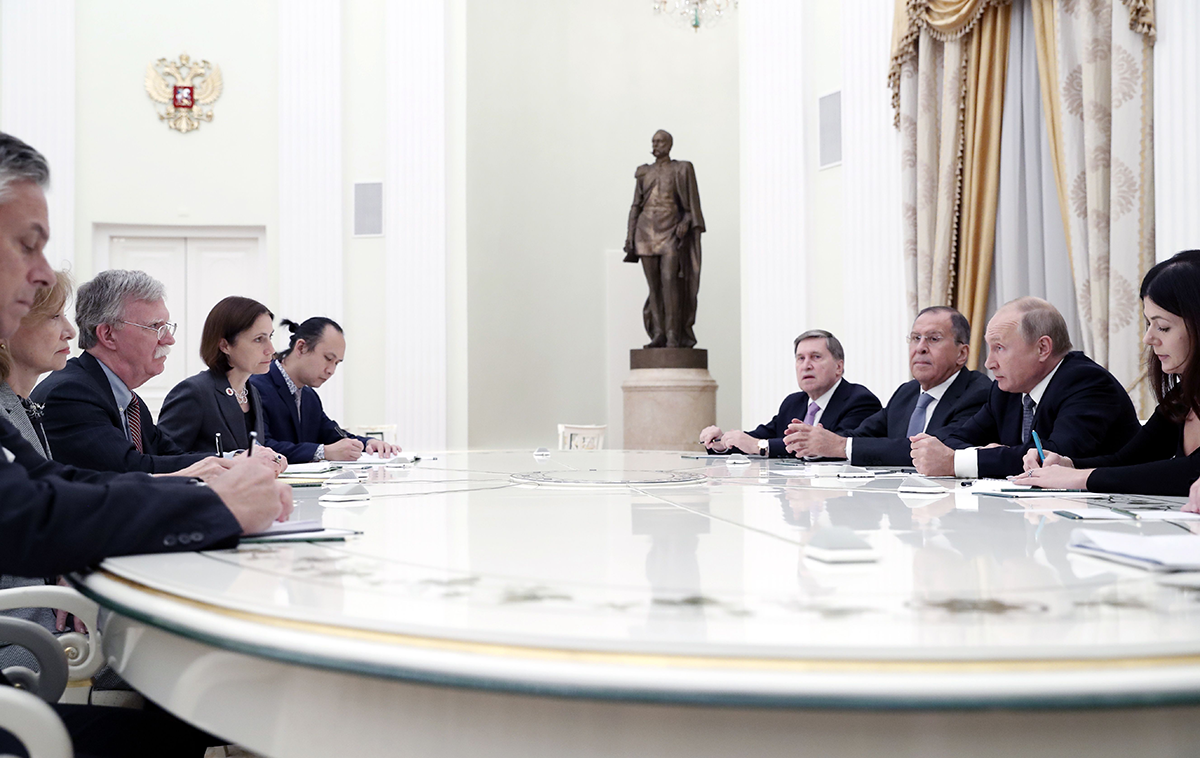
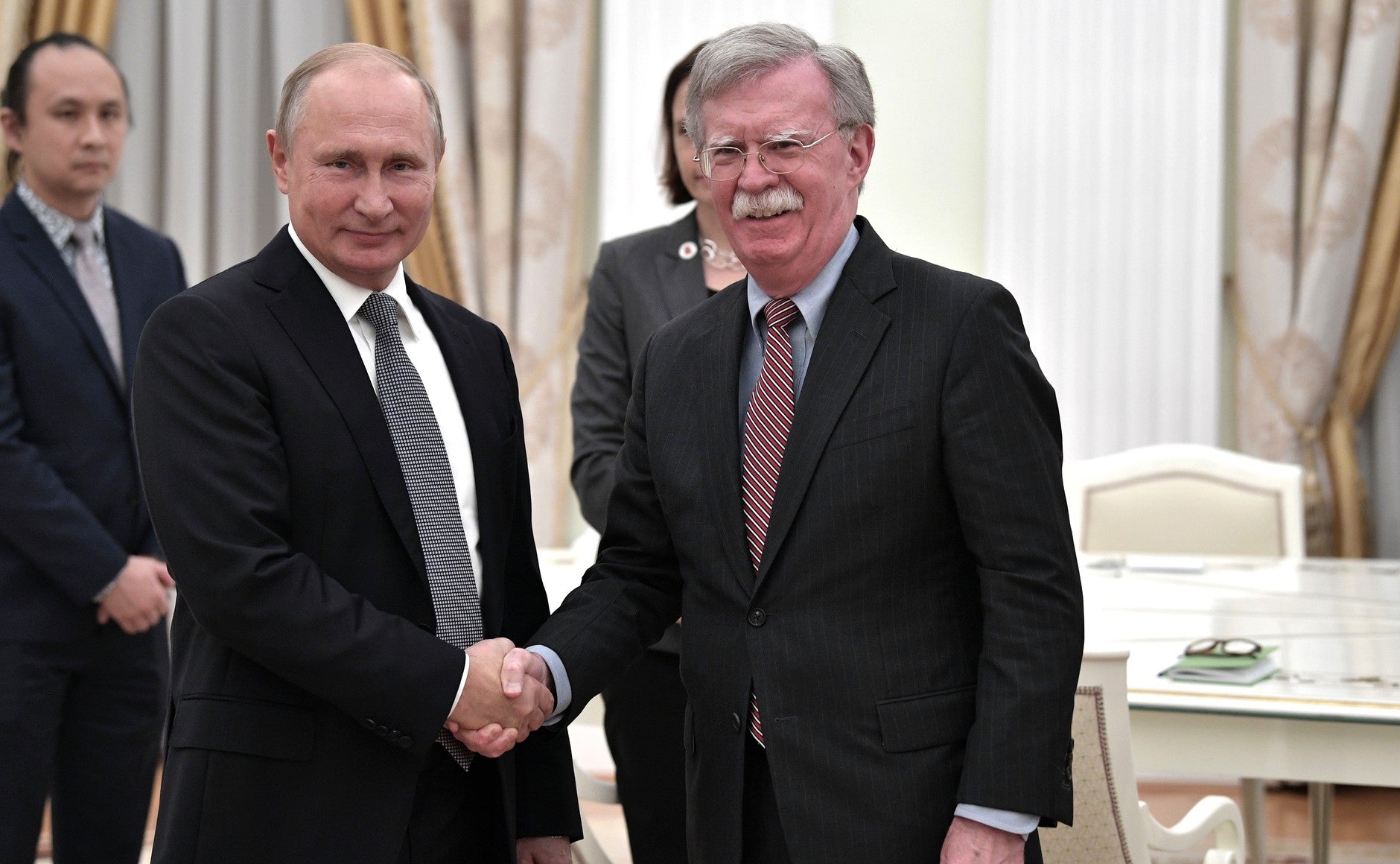
Russian President Vladimir Putin meets with John Bolton, National Security Adviser to the U.S. President, at the Kremlin in Moscow on October 23, 2018. (Photo: Maxim Shipenkov/AFP/Getty Images)
Worse yet, Trump’s national security team has dithered for more than a year on beginning talks with Russia to extend the 2010 New Strategic Arms Reduction Treaty (New START) before it expires in February 2021. It is now apparent that Bolton is trying to steer Trump to discard New START.
In an interview published June 18, he spoke of a New START extension, saying, “[T]here's no decision, but I think it's unlikely.”
Without New START, there would be no legally binding, verifiable limits on the U.S. or Russian nuclear arsenals for the first time in nearly half a century. Today, the treaty caps the number of deployed warheads at 1,550 for each side; if that ceiling expires, Russia and the United States could upload hundreds of additional nuclear warheads to their long-range delivery systems.
Bolton argued that a key flaw of New START is that it has no provisions or limitations on tactical, or nonstrategic, nuclear weapons. “So simply extending it,” he said, “extends the basic flaw."
New START was designed to focus on the long-range nuclear weapons that pose the greatest threat to the United States and Russia. Talks on eliminating both countries' short-range tactical nuclear weapons are overdue, but would not be easy. If U.S. negotiators seek limits on Russia’s estimated 2,000 tactical nuclear weapons that are kept in central storage, Russia is sure to press the United States to remove the 180 tactical nuclear bombs it now deploys in five European NATO countries. Also, Russia will likely seek to limit French and UK nuclear arsenals.
Bolton further suggested that new strategic weapons being developed by China and Russia, including hypersonic glide vehicles, and other new delivery vehicles “are simply not effectively covered by New START.”
In fact, if Russia deploys its Avangard hypersonic weapon, which is launched by an intercontinental ballistic missile (ICBM), the weapon would be covered by New START, according to the State Department. Also, Washington could insist that any new Russian strategic nuclear delivery system, whether a long-range torpedo or missile, also be subject to New START limits.
Bolton also argued that Trump wants to bring China into trilateral negotiations with Russia on a new agreement to limit nuclear weapons not covered by New START.
Pursuing talks with other nuclear-armed states and trying to limit all types of nuclear weapons is an admirable objective, but such a negotiation would be complex and time-consuming. It would be malpractice to discard New START in the hopes of negotiating a more comprehensive, ambitious nuclear arms control agreement with Russia and China and getting it ratified and into force.
There is no realistic chance a new agreement along these lines could be finalized before New START expires. The first step should be a five-year extension of New START, which would provide a foundation for a more ambitious successor agreement.
Bolton’s malign influence on U.S. arms control and international security objectives requires that Congress make it clear that the evisceration of common-sense arms control is unacceptable.
A bill introduced by a bipartisan coalition led by House Foreign Affairs Committee Chairman Eliot Engel (D-N.Y.) and Rep. Mike McCaul (R-Texas), the committee’s ranking member, calls for extending New START as long as Russia remains in compliance, or until a new treaty that“provides equal or greater constraints” enters into force. It would also require intelligence assessments of how New START’s expiration would affect the size and posture of Russian nuclear forces and of the additional intelligence capabilities that would be needed to compensate for losing the treaty’s extensive transparency and on-site monitoring provisions.
Meanwhile, Sens. Edward Markey (D-Mass.) and Elizabeth Warren (D-Mass.) have launched a bill to prohibit any funding for nuclear weapons that would violate New START limits as long as Russia continues to stay below treaty ceilings. Such an approach would guard against a breakout by either side and help to maintain strategic stability.
If Trump continues to listen to Bolton’s advice and allows New START to expire, he will likely become the first president since John Kennedy to fail to conclude at least one agreement with Russia to reduce nuclear dangers, and he will have opened the door to a new and dangerous nuclear arms race.
Last year, President Donald Trump told reporters that he wanted to work with Russian President Vladimir Putin “to discuss the arms race, which is getting out of control.”

July/August 2019
By 
Shervin Taheran and Daryl G. Kimball
Prospects for extending the 2010 New Strategic Arms Reduction Treaty (New START) dimmed in late June as U.S. National Security Advisor John Bolton criticized the pact that is due to expire in February 2021.
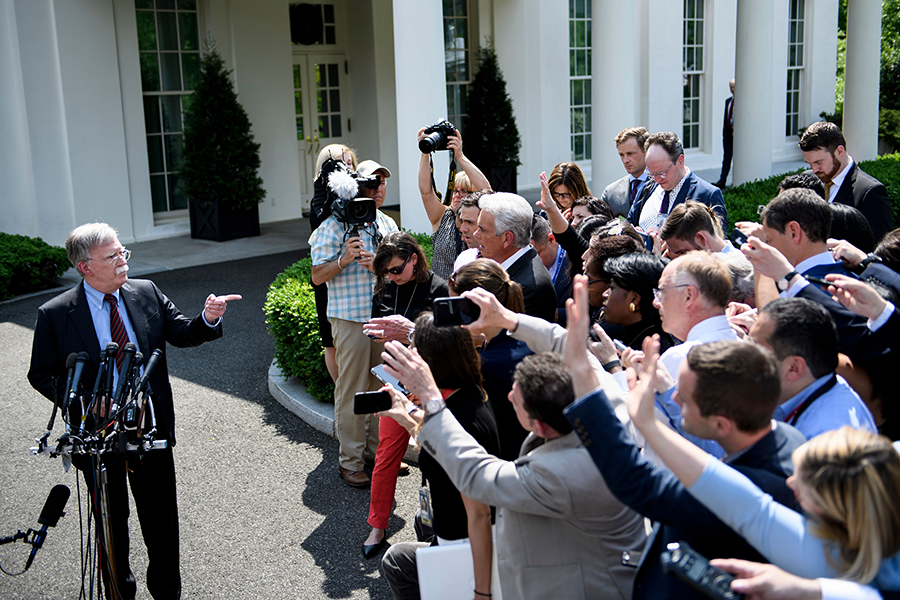
U.S. National Security Advisor John Bolton speaks outside on the White House on April 30. In a June interview, Bolton said “it’s unlikely” that New START will be extended. (Photo: Brendan Smialowski/AFP/Getty Images)
“There’s no decision, but I think it’s unlikely,” he told the Washington Free Beacon in an interview published June 18. His comments came less than a week after top U.S. and Russian arms control diplomats met in Prague to discuss the resumption of talks on strategic stability and the future of New START.
In his interview, Bolton said most Republican senators who voted to approve New START in 2010 actually opposed the treaty, primarily because the pact has no provisions or limitations on tactical or non-strategic nuclear weapons. “That flaw remains today,” he said, “so simply extending it, extends the basic flaw.”
The treaty was negotiated to last 10 years after its entry into force, but it can be extended by up to five years by mutual agreement of the U.S. and Russian presidents.
Russian President Vladimir Putin told reporters on June 6 that Russia is prepared to let New START lapse if the Trump administration is not interested in extending the agreement. Russia has “already said a hundred times that we are ready to do so, but no one is willing to talk about it with us,” he said. Putin and President Donald Trump are expected to briefly meet at a late-June Group of 20 summit in Japan.
U.S. and Russia Reach ‘Starting Point’ for Dialogue
A June 12 meeting in Prague between Andrea Thompson, U.S. undersecretary of state for arms control and international security, and Russian Deputy Foreign Minister Sergey Ryabkov was their fourth meeting this year, but the first where “strategic security issues on which the United States would like to engage in a more constructive dialogue with Russia” were discussed, according to the State Department.
Senior U.S. and Russian officials last met for a dialogue on strategic stability in Helsinki in September 2017, but a subsequent conversation scheduled to take place in early 2018 was canceled. (See ACT, October 2017.) The previous meetings between Ryabkov and Thompson this year were largely focused on the narrower issue of the 1987 Intermediate-Range Nuclear Forces Treaty.
The recent discussion followed a May meeting between U.S. Secretary of State Mike Pompeo with Russian Foreign Minister Sergey Lavrov and Putin in Sochi. Pompeo told reporters after the meeting that the two nations would soon “gather together teams” to discuss New START and its potential extension, as well as “a broader range of arms control issues.” (See ACT, June 2019.)
After his latest meeting with Thompson, Ryabkov told Russian journalists that it was a “starting point” for further conversations and negotiations and that both sides recognized the importance of continued dialogue. Prior to the meeting, Ryabkov said on June 7 that Russia intended to discuss New START, prospects for next year’s nuclear Nonproliferation Treaty (NPT) review conference, U.S. allegations about Russian compliance with the Comprehensive Test Ban Treaty, and the prospect of space-based weapons and U.S. missile defense systems.
The two diplomats also discussed the Trump administration’s recently stated desire for a more comprehensive nuclear arms control agreement that would include China, according to Ryabkov’s June 12 statement to reporters. (See ACT, June 2019.) He added that although a multilateral process was a good idea, it must involve all five nuclear-weapon states recognized under the NPT, including France and the United Kingdom.
Meanwhile, Russia had sent several proposals to the United States over the past year on strategic stability and arms control, according to Lavrov. Russia “expects specific responses” to proposals that “cover the entire range of issues of strategic stability,” as well as “control over nuclear and other strategic offensive and defensive weapons,” he said, adding that one of the proposals “of fundamental importance” is for both countries to reaffirm “at the top level” that “a nuclear war cannot be won, and therefore it is unacceptable.”
Congress Urges New START Extension
Eight Senate and House Democratic committee leaders sent a June 4 letterto Trump encouraging him to extend
New START.
Forgoing “the benefits of New START by failing to extend the agreement would be a serious mistake for strategic stability and U.S. security,” they wrote.
The letter praised the administration’s “effort aimed at bringing both China and Russia into new arms control talks,” but stressed that, in light of “the challenges inherent to reaching new agreements with Russia and China, we strongly believe the limitations and verification measures of New START must remain in place while any such negotiation occurs.”
The letter was signed by the Democratic leaders of the House and Senate foreign affairs committees, Rep. Eliot Engel (D-N.Y.) and Sen. Bob Menendez (D-N.J.); the House and Senate armed services committees, Rep. Adam Smith (D-Wash.) and Sen. Jack Reed (D-R.I.); the House and Senate intelligence committees, Rep. Adam Schiff (D-Calif.) and Sen. Mark Warner (D-Va.); and the House Appropriations defense subcommittee and Senate Appropriations defense subcommittee, Rep. Pete Visclosky (D-Ind.) and Sen. Richard Durbin (D-Ill.).
Engel and the ranking Republican on the House Committee on Foreign Affairs, Rep. Michael McCaul (R-Texas), also continue to pursue House approval of their bill which expresses the sense of congress that the United States should seek to extend the New START so long as Russia remains in compliance. Their bill would also require several briefings and reports, including an intelligence assessment of how the expiration of New START would affect the size and posture of Russian nuclear forces and the additional intelligence capabilities the United States would need to compensate for the loss of the treaty’s extensive transparency and on-site monitoring provisions.

Eleventh Hour for the INF Treaty
The United States and Russia have continued to set the stage for the demise of the Intermediate-Range Nuclear Forces (INF) Treaty, slated to expire Aug. 2 after the U.S. announcement of its withdrawal plans in early February.
The Defense Department has requested nearly $100 billion in fiscal year 2020 to develop three new missile systems that would exceed the range limits of the treaty, but the Democratic-led House of Representatives has expressed concern about the rationale for the missiles.
The House versions of the fiscal year 2020 National Defense Authorization Act and defense appropriations bill zeroed out the Pentagon’s funding request for the missiles. On June 18, House Democrats defeated an attempt by Republicans on the floor of the House to restore the funding by a vote of 225–203.
On June 18, Russian Deputy Foreign Minister Sergey Ryabkov reiterated Russia’s position that it will not deploy INF Treaty-range missiles until the United States does. The United States alleges that Russia has already deployed the treaty-noncompliant 9M729 missile, also known as the SSC-8. (See ACT, March 2019.) Ryabkov made his comments as the Russian State Duma supported legislation submitted by Russian President Vladimir Putin to suspend Russia’s participation in the INF Treaty. The upper parliamentary body, the Federation Council, is expected to approve the legislation soon.
NATO defense ministers met in Brussels on June 26 to discuss defense and deterrence measures “to ensure the security of the alliance” if Russia fails to resolve U.S. allegations of treaty noncompliance. In remarks to reporters June 25, NATO Secretary General Jens Stoltenberg said, “Russia has until 2 August to verifiably destroy its SSC-8 missiles, which violate the treaty. But unfortunately, we have seen no indication that Russia intends to do so.”
Stoltenberg said the ministers “will decide on NATO’s next steps, in the event Russia does not comply. Our response will be defensive, measured and coordinated. We will not mirror what Russia does. We do not intend to deploy new land-based nuclear missiles in Europe. We do not want a new arms race. But as Russia is deploying new missiles, we must ensure that our deterrence and defense remains credible and effective.”—SHERVIN TAHERAN
NOTE -- These words may sound reassuring, but Stoltenberg fails to mention that NATO will soon entertain an American scheme to deploy ground-launched cruise missiles and other intermediate-range missiles in Europe. The Trump administration is pressing Congress for $100 million for a program to develop and test the missiles. The Department of Defense plans to begin flight testing a ground-based variant of its Tomahawk ground-launched cruise missile (GLCM) just a few weeks after it pulls out of the INF Treaty August 2. https://www.armscontrol.org/blog/2019-07-15/nato-secretary-general-stoltenbergs-inf-response-inadequate

Thursday, July 11, 2019

Seeing Red in Trump’s Iran Strategy


July/August 2019
By Eric Brewer and Richard Nephew
Since Iran’s May 2019 announcement that it would no longer abide by some nuclear restrictions under the Joint Comprehensive Plan of Action (JCPOA), the Trump administration has sought to push back against these moves by citing the imperative of the JCPOA’s constraints. The JCPOA created limits on Iran’s nuclear fuel cycle that mean Tehran would need a year to produce enough nuclear material for a bomb, and the agreement established enhanced transparency and inspector access throughout the entire fuel cycle.
U.S. National Security Advisor John Bolton speaks to reporters at the White House April 30. Bolton has linked any Iranian expansion of enrichment activities to a deliberate attempt to shorten the breakout time to produce nuclear weapons.  (Photo: Brendan Smialowski/AFP/Getty Images)
U.S. National Security Advisor John Bolton speaks to reporters at the White House April 30. Bolton has linked any Iranian expansion of enrichment activities to a deliberate attempt to shorten the breakout time to produce nuclear weapons. (Photo: Brendan Smialowski/AFP/Getty Images)
The U.S. push for Iran to adhere to the deal’s terms has drawn some international incredulity given how the United States withdrew from agreement in May 2018 while noisily alleging many JCPOA flaws. More subtly, the Trump administration has begun to lay the groundwork for what can be described as its first real redline for the nuclear program: that any reduction in Iran’s one-year breakout timeline, the amount of time Iran would need to produce enough enriched uranium for a bomb, is unacceptable.
It is unclear how much reduction the administration would tolerate, what its response would be, and given President Donald Trump’s avowed preference for a deal and to avoid another conflict in the Middle East, whether it would be enforced at all. Yet, National Security Advisor John Bolton in late May linked any Iranian expansion of enrichment activities to a deliberate attempt to shorten the breakout time to produce nuclear weapons, which would suggest that a severe response, perhaps even military force, would be on the table to prevent Iran from a nuclear restart. At the very least, the United States is shifting the traditional definition of what is unacceptable from a weapon or having the ability to produce one quickly to any deviation from JCPOA baseline restrictions.

Thursday, November 1, 2018

'Troika of Tyranny': Trump White House announces tough new policies against Venezuela, Cuba and Nicaragua


The confrontational remarks from John Bolton come same day as United Nations calls on US to lift Cuban embargo


The Independent US

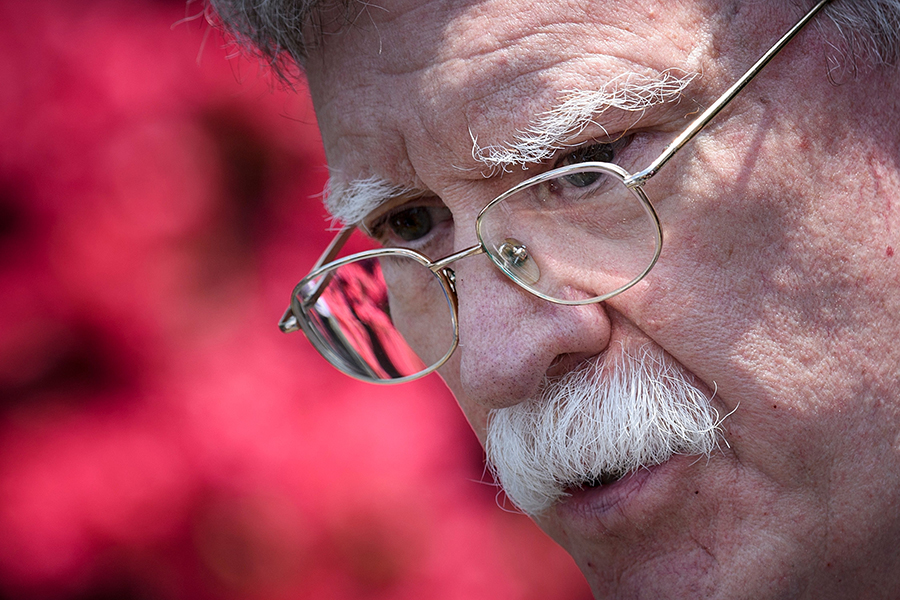
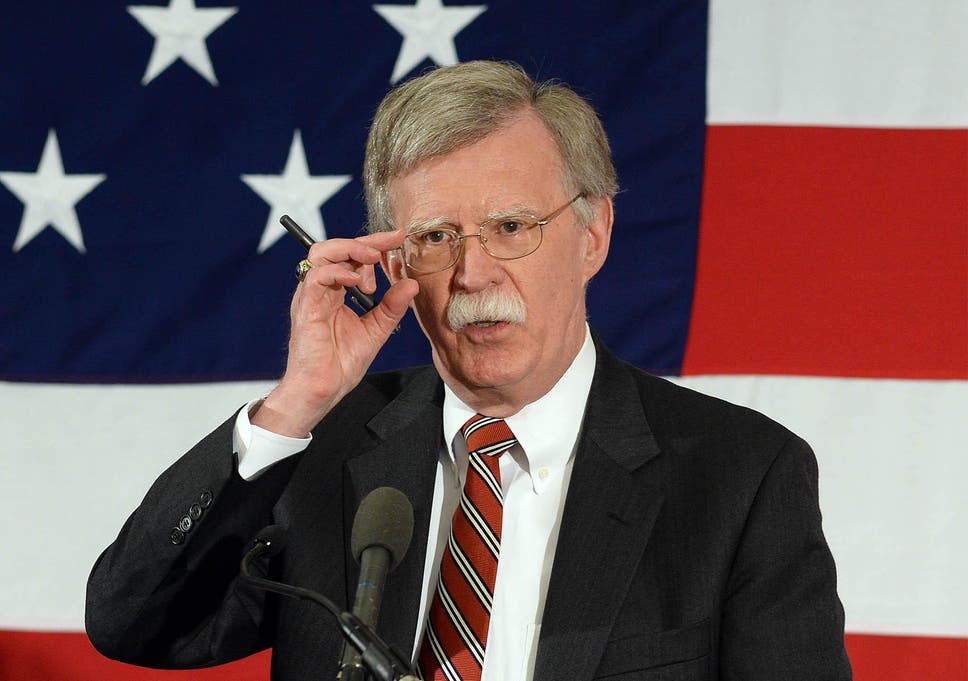
John Bolton is national security advisor to Donald Trump
John Bolton is national security advisor to Donald Trump ( Getty )
Donald Trump's White House has announced an aggressive new policy to confront the governments of Cuba, Venezuela and Nicaragua, labelling the three nations the “troika of tyranny”. 
“Many of you in the audience today have personally suffered unspeakable horrors at the hands of the regimes in Cuba, Venezuela, and Nicaragua, only to survive, fight back, conquer, and overcome,” John Bolton, Mr Trump's national security advisor said during a speech in Miami, Florida. “The troika of tyranny in this hemisphere - Cuba, Venezuela and Nicaragua - has finally met its match,” he said.
The remarks came the same day the United Nations General Assemblyoverwhelmingly adopted its 27th annual resolution calling for an end to the nation's economic embargo on Cuba, after a failed bid by Washington to amend the text to push Cuba to improve its human rights  
The UN vote can carry political weight, but only the US Congress can lift the more than 50-year-old embargo. The United States and Israel voted against the resolution, 189 countries voted in favour and Ukraine and Moldova did not vote.
Watch more
Mr Bolton promised a tough stance by the Trump administration towards “dictators and despots near our shores” and singled out Venezuela, Cuba and Nicaragua in a speech in Miami, which is home to large numbers of migrants from Cuba and Venezuela.

Sunday, April 8, 2018

'I give you 24 hours to resign': 1st OPCW chief on how John Bolton bullied him before Iraq War

'I give you 24 hours to resign': 1st OPCW chief on how John Bolton bullied him before Iraq War

The first OPCW chief, who tried to bring Iraq and Libya into the organization, told RT how US foreign policy hawk John Bolton threatened him over his refusal to resign prior to the 2003 Iraq War.
Jose Bustani, the first director-general of the global chemical weapons watchdog Organization for the Prohibition of Chemical Weapons (OPCW), sat down with RT and revealed how John Bolton, a Bush-era official and now Donald Trump's pick for National Security Adviser, bulldozed the way for the 2003 Iraq invasion.
Bustani, a Brazilian diplomat, led the organization from 1997 until 2002, when he was ousted after falling out of favor with the US. At the time, he was trying to convince Iraq and Libya to join the organization, meaning that the two countries would have been obliged to dispose of all chemical weapons if they had any.
He said that according to reliable intelligence he had as director-general, "it was obvious that during the first Iraq War everything had been destroyed [by Iraq]," and there was "nothing left for Iraq to be accused of possessing chemical weapons."
In 2001, OPCW inspectors examined Iraqi facilities, and it was "a successful operation," after which Bustani's informal dialogue with the Iraqis and Libyans about joining the organization made a breakthrough, he recalled.
But diplomatic efforts and peacemaking did not sit well with Washington, because "they had plans already to take some action – military action – against Iraq," Bustani claims. Shortly afterwards, the Bush administration began to aggressively lobby for his removal, and it became "a tragic story" for him, he said.
"I got a phone call from John Bolton – it was first time I had contact with him – and he said he had instructions to tell me that I have to resign from the organization, and I asked him why," Bustani told RT. "He said that [my] management style was not agreeable to Washington."
He resolutely refused to resign, only to see Bolton again at OPCW headquarters in The Hague several weeks after the phone conversation. "He came to my office and said: 'You have to resign and I give you 24 hours, this is what we want. You have to leave, you have to resign from your organization, director-general.'"
Bustani said he "owed nothing" to the US, pointing out that he was appointed by all OPCW member states. Striking a more sinister tone, Bolton said: "OK, so there will be retaliation. Prepare to accept the consequences. We know where your kids are."
According to Bustani, two of his children were in New York at the time, and his daughter was in London. He told Bolton: "My family is aware of what's going on, so [they're] prepared to face consequences." The reply shocked Bolton, who then left the office.
On April 21, 2002, a special meeting was finally held in The Hague, and Bustani's removal was carried out by a vote of 48–7, with 43 abstentions. The diplomat said those who abstained were from developing countries, and that his own government in Brazil "left me behind."
"He's not a man you can have a dialogue with," Bustani said when asked about his opinion on the newly-appointed National Security Adviser. "On the basis of my own experience, I don't believe that Mr. Bolton is capable of being a National Security Adviser to any government of the United States."
Bolton, who was Under Secretary of State for Arms Control and International Security in the Bush administration from 2002-2004, and ambassador to the UN, "has prejudices, he made a number of announcements that are worrisome,"including on North Korea, Iran, and Syria.
The latter is critical, Bustani says, "because it could be a new Iraq with much more serious consequences with impact on the whole Middle East today.
"And I believe that, as a result of the Iraqi invasion, for example, you have today Daesh [Arabic acronym for Islamic State (IS, formerly ISIS)] and… different fanatic Islamic movements" tearing the region apart.

Saturday, April 7, 2018

How bad is John Bolton? If he worked for Iran, the US would label him a fundamentalist extremist


The situation is starting to resemble a Hollywood-style, Wag-the-Dog, drum-up-a-war-to-distract-the-populace scenario.
April 7, 2018, 10:25
Major Danny Sjursen, a TomDispatch regular, is a U.S. Army officer and former history instructor at West Point. He served tours with reconnaissance units in Iraq and Afghanistan. He has written a memoir and critical analysis of the Iraq War, Ghost Riders of Baghdad: Soldiers, Civilians, and the Myth of the Surge. He lives with his wife and four sons in Lawrence, Kansas. Follow him on Twitter at @SkepticalVet and check out his new podcast Fortress on a Hill, co-hosted with fellow vet Chris ‘Henri’ Henriksen.
Sometimes I get sick of saying it, but just when you thought it couldn’t get any worse…
Donald Trump’s continual cabinet reshuffling — otherwise the stuff of reality-TV drama — has become genuinely frightening. Like so many Russian matryoshki or nesting dolls, the president has been removing one war hawk after another, only to reveal yet more extreme versions of the same creature. And rumor has it that such personnel moves have yet to reach their end point.
In just the last few weeks, President Trump has fired his secretary of state and national security adviser, while nominating two fanatical replacements: CIA Director Mike Pompeo and former U.N. Ambassador John Bolton. The “old” team, Rex Tillerson and Lieutenant General H.R. McMaster, were flawed choices from the start, but Pompeo and Bolton seem like an instant formula for a war — or two or three of them. (And keep in mind that we’re already actively fighting at least seven wars across the Greater Middle East and Africa.)

Manifestações

2007 Speech

UKRAINE ON FIRE

Discurso do Presidente da Rússia, Vladimir Putin, na manhã do dia 24 de Fevereiro de 2022

Discurso do Presidente da Rússia, Vladimir Putin, Tradução em português


Presidente da Rússia, Vladimir Putin: Cidadãos da Rússia, Amigos,

Considero ser necessário falar hoje, de novo, sobre os trágicos acontecimentos em Donbass e sobre os aspectos mais importantes de garantir a segurança da Rússia.

Começarei com o que disse no meu discurso de 21 de Fevereiro de 2022. Falei sobre as nossas maiores responsabilidades e preocupações e sobre as ameaças fundamentais que os irresponsáveis políticos ocidentais criaram à Rússia de forma continuada, com rudeza e sem cerimónias, de ano para ano. Refiro-me à expansão da NATO para Leste, que está a aproximar cada vez mais as suas infraestruturas militares da fronteira russa.

É um facto que, durante os últimos 30 anos, temos tentado pacientemente chegar a um acordo com os principais países NATO, relativamente aos princípios de uma segurança igual e indivisível, na Europa. Em resposta às nossas propostas, enfrentámos invariavelmente, ou engano cínico e mentiras, ou tentativas de pressão e de chantagem, enquanto a aliança do Atlântico Norte continuou a expandir-se, apesar dos nossos protestos e preocupações. A sua máquina militar está em movimento e, como disse, aproxima-se da nossa fronteira.

Porque é que isto está a acontecer? De onde veio esta forma insolente de falar que atinge o máximo do seu excepcionalismo, infalibilidade e permissividade? Qual é a explicação para esta atitude de desprezo e desdém pelos nossos interesses e exigências absolutamente legítimas?

Read more

ARRIVING IN CHINA

Ver a imagem de origem

APPEAL


APPEAL TO THE LEADERS OF THE NINE NUCLEAR WEAPONS' STATES

(China, France, India, Israel, North Korea, Pakistan, Russia, the United Kingdom and the United States)

中文 DEUTSCH ENGLISH FRANÇAIS ITALIAN PORTUGUESE RUSSIAN SPANISH ROMÂNA

manlio + maria

MOON OF SHANGHAI site

LR on CORONAVIRUS

LARRY ROMANOFF on CORONAVIRUS

Read more at Moon of Shanghai

World Intellectual Property Day (or Happy Birthday WIPO) - Spruson ...


Moon of Shanghai

L Romanoff

Larry Romanoff,

contributing author

to Cynthia McKinney's new COVID-19 anthology

'When China Sneezes'

When China Sneezes: From the Coronavirus Lockdown to the Global Politico-Economic Crisis

manlio

James Bacque

BYOBLU

irmãos de armas


Subtitled in PT, RO, SP

Click upon CC and choose your language.


manlio

VP


Before the Presidential Address to the Federal Assembly.


The President of Russia delivered
the Address to the Federal Assembly. The ceremony took
place at the Manezh Central Exhibition Hall.


January
15, 2020


vp

President of Russia Vladimir Putin:

Address to the Nation

Address to the Nation.

READ HERE


brics


Imagem

PT -- VLADIMIR PUTIN na Sessão plenária do Fórum Económico Oriental

Excertos da transcrição da sessão plenária do Fórum Económico Oriental

THE PUTIN INTERVIEWS


The Putin Interviews
by Oliver Stone (
FULL VIDEOS) EN/RU/SP/FR/IT/CH


http://tributetoapresident.blogspot.com/2018/07/the-putin-interviews-by-oliver-stone.html


TRIBUTE TO A PRESIDENT


NA PRMEIRA PESSOA

Um auto retrato surpreendentemente sincero do Presidente da Rússia, Vladimir Putin

CONTEÚDO

Prefácio

Personagens Principais em 'Na Primeira Pessoa'

Parte Um: O Filho

Parte Dois: O Estudante

Parte Três: O Estudante Universitário

Parte Quatro: O Jovem especialista

Parte Cinco: O Espia

Parte Seis: O Democrata

Parte Sete: O Burocrata

Parte Oito: O Homem de Família

Parte Nove: O Político

Apêndice: A Rússia na Viragem do Milénio


contaminação nos Açores


Subtitled in EN/PT

Click upon the small wheel at the right side of the video and choose your language.


convegno firenze 2019