GIULIETTO CHIESA

FREE JULIAN ASSANGE

WWIII + S SITE


CROATIAN   ENGLISH   GREEK   NEDERLANDS   POLSKI   PORTUGUESE   ROMANIAN  SPANISH  РУССКИЙ

What part will your country play in World War III?

By Larry Romanoff

The true origins of the two World Wars have been deleted from all our history books and replaced with mythology. Neither War was started (or desired) by Germany, but both at the instigation of a group of European Zionist Jews with the stated intent of the total destruction of Germany. The documentation is overwhelming and the evidence undeniable. (1) (2) (3) (4) (5) (6) (7) (8) (9) (10) (11)

That history is being repeated today in a mass grooming of the Western world’s people (especially Americans) in preparation for World War IIIwhich I believe is now imminent

READ MORE


Showing posts with label japan. Show all posts

Friday, July 2, 2021

The Gruesome Contest Between Two Soldiers Trying To Kill 100 With Their Samurai Swords


The Gruesome Contest Between Two Soldiers Trying To Kill 100 With Their Samurai Swords

By Wyatt Redd

Published January 16, 2018

During the Second Sino-Japanese War, a Japanese newspaper reported on the barbaric killing competition as though it were a sporting event.


Wikimedia CommonsAn article reporting on the “Contest to Cut Down 100 People.”

In 1937, during the Second Sino-Japanese War, the Empire of Japan invaded China, and for the next eight years, committed horrific atrocities against the civilian population. But while the international press was reporting on the brutality of Japanese troops, newspapers in Japan were looking for stories of wartime heroism. One of the stories they quickly settled on was that of two officers and an unusual contest.

Just after the start of the invasion, the Osaka Mainichi Shimbun ran an article titled “Contest to kill 100 People using a sword.” As the article explained, two officers, Tsuyoshi Noda and Toshiaki Mukai, had settled on a private competition to see which of them could be the first to kill 100 enemy soldiers with their katanas. By the time the paper first reported the story, the competition was already fierce.

“Since leaving Wuxi,” the paper reported, “one has already killed fifty-six men, and the other has succeeded in killing twenty-five.” Over the next few days, the paper followed the two soldiers, keeping careful track of their scores. “Second Lieutenant N broke into an enemy pillbox…[and] killed four enemy,” the paper continued, “When Second Lieutenant M heard this, he invaded an enemy camp at Henglinzen…and laid fifty-five enemy low with his sword.”


Wednesday, July 15, 2020

Lucero Oyarzu -- This is why nuclear weapons tests are so devastating

lucero oyarzun (@luceritooyarzun) | Twitter
 Lucero Oyarzu:
This is why nuclear weapons tests are so devastating!
Dear Reader--
Before nuclear weapons were used on the populations of Hiroshima and Nagasaki, they were tested in New Mexico. On July 16th, we commemorate the 75th anniversary of the first nuclear test, Trinity, which not only led to the use of nuclear weapons in warfare in Japan, but more than 2000 additional nuclear tests worldwide.
As the Trump administration threatens to resume nuclear testing again, here are 5 things you should know about nuclear tests:
    1. The Trinity test exposed the communities in the areas downwind from the blast to dangerous levels of radiation and fallout. In the following decades, the "Downwinders" from the Tularosa Basin faced long-term health consequences including cancers, even across generations. You can read some of their testimonies here, or, hear their stories directly in a webinar organised by our partner, ICAN Australia only a few hours from now!

    2. Of the 2,000+ nuclear tests carried out by the 9 nuclear-armed states at more than 60 locations around the globe, most took place on colonized land and the lands of indigenous and minority people, never close to those who made the decisions to conduct them. The history of nuclear testing exposes the oppressive and racist nature of relying on nuclear weapons for “security”.
    3. Radiation from nuclear tests harms children more than it does adults. Infants and young girls run the highest risk of cancer across their lifetime after exposure and teenage girls will suffer almost double rates of cancer compared to boys.

Sunday, May 24, 2020

PT -- Coronavírus da China - Uma actualização chocante. Será que o vírus foi originado nos EUA?

Relatórios do Japão, da China e de Taiwan sobre a origem do vírus
Global Research, March 04, 2020


A comunicação mediática ocidental subiu rapidamente ao palco e expôs a narrativa oficial sobre o surto do novo coronavírus, que parecia ter começado na China, alegando que ele se originou em animais num mercado húmido, em Wuhan.
De facto, a origem foi desconhecida durante muito tempo, mas agora, parece provável, de acordo com relatos japoneses e chineses, que o vírus se originou noutros lugares, de vários locais, mas só começou a espalhar-se largamente depois de ser introduzido no mercado.
Mais precisamente, parece que o vírus não se originou na China e, de acordo com relatos em japonês e outras comunicações sociais, pode ter sido originado nos EUA.
Os Pesquisadores chineses concluem que o vírus foi originado fora da China
Depois de recolher amostras do genoma na China, os médicos pesquisadores demonstraram conclusivamente o seguinte:
– Em primeiro lugar, que o vírus não se originou no mercado de marisco, mas que tinha várias fontes não identificadas
– Em segundo lugar, foi exposto no referido mercado de marisco, de onde se espalhou por toda a parte. (1) (2) (3)

Monday, January 13, 2020

F. William Engdahl -- Scientists Call For Ban on Human Gene Editing


12.01.2020 Author: F. William Engdahl
Column: Society
Region: Eastern Asia
BIO3422
Japan has banned gene-edited human embryos and international scientists are increasing the call to ban the highly uncertain and risky practice of gene-editing of human DNA. The growing opposition comes as details of a Chinese biologist’s attempt to gene-edit embryos to resist HIV led to massive criticism of the flawed experiment. While the technology of altering DNA of humans, plants, animals is still in its infancy, the rate at which it is spreading worldwide with little oversight gives cause for alarm.
In December, 2019 the Japanese Health Ministry recommended a ban on implanting genetically modified human embryos. They warned such procedures could lead to a market for ‘designer babies.’ They follow recommendations of a panel of experts who warned that allowing gene-edited human embryos to be placed in the uterus for gestation held very serious health risks for both the infant and for future generations. In 2018 the Japanese government had moved to permit gene-editing of human embryos.
The latest decision by Japan to call for a ban on using the gene-edited embryos to give birth to gene-altered babies is a clear reaction to worldwide protest against a Chinese biologist who reported he had gene edited twins to be immune to HIV. It was the first report of babies born who had been genetically edited with CRISPR. Since then a growing number of scientists have called for a moratorium on gene editing of humans. Feng Zhang, a member of the Broad Institute of MIT and Harvard and the co-inventor of CRISPR/Cas9, has called for a moratorium on gene-edited babies. Nobel laureate David Baltimore said the He human experiment showed “there has been a failure of self-regulation in the scientific community.”
Human gene experiments

Tuesday, December 3, 2019

LARRY ROMANOFF -- The World’s Safest Cities

The World’s Safest Cities

Region: 
Theme: 

There are occasions where the Americans want to publish a list that demonstrates their innate moral superiority over the rest of the world, but they hesitate because the lies are too large even for them and would expose them to unlimited ridicule.
In such instances, they have a friend do their work for them, depending on a highly-regarded third-party reference in an attempt to make the hypocrisy more palatable. On this occasion, they enlisted the services of the Economist Magazine’s so-called “Intelligence Unit” to produce a list of the world’s safest cities. The results should surprise even you, with places like Chicago, Washington, New York and Los Angeles placing right up there near the top. (1)
The methodology was innovative to say the least. To most of us a safe city is one where we are safe; that means personal safety, with little or no likelihood of experiencing the normal events of daily life in America which would include being mugged, killed, raped, stabbed, framed by the FBI, or shot dead by the police.
But American cities cannot compete on these metrics so, with the help of their friends in the UK, designed new metrics in four categories, namely digital security, health security, infrastructure safety, and personal safety, each allotted 25% of the total ranking. So now getting shot by the police in New York or stabbed by one of the 400,000 muggers in Chicago or Washington assumes equal importance with losing your credit card or tripping on the sidewalk. Let’s take a quick look.

Friday, November 8, 2019

Larry Romanoff -- Japan – Ending a War and Saving Lives? By Larry Romanoff


Global Research, November 04, 2019
Region: AsiaUSA
 
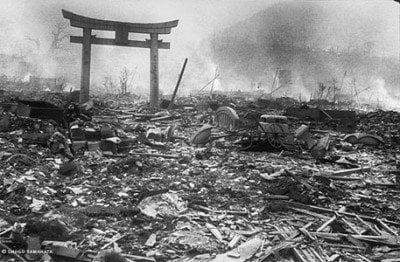
A couple of years ago an American writer named Greg Mitchell wrote an informative book on the huge cover-up orchestrated by the US government on the dropping of the first atomic bomb on Japan, and the censorship of the first Hollywood movie on the subject. (1) The government was in possession of much live film footage shot by the US military of both Hiroshima and Nagasaki that Mitchell says would have shocked viewers, with ghostlike ruins and babies with burned faces. He includes many of these original photos in his book, and details the extensive efforts to hide the facts and evidence of the use of the atomic bombs and the tapestry of lies created after the fact to justify this atrocity and present it as a necessary evil.
The Hollywood movie arose because the film industry wanted to warn the people of the world about the coming dangers of a nuclear arms race, Mitchell claiming the early scripts presented a shocking picture that would definitely have provoked disarmament, but the eventual Hollywood version of the official narrative was that the bomb was absolutely necessary to end the war and save American lives.
He writes that as the scripts were increasingly revised the bombing became not only justifiable but even admirable. Robert Oppenheimer, the prominent Jewish physicist primarily responsible for the development of the bomb, was assured that in the movie his character would display “humility” and “a love of mankind”. But that’s not quite how it was. “At the first successful detonation of an atomic bomb on July 16, 1945, “Oppenheimer was beside himself at the spectacle. He shrieked, “I am become Death, the Destroyer of worlds.” (2)
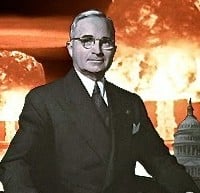
The movie script was further altered to show American president Truman agonising over the decision when in truth he proudly boasted that he never lost any sleep over it, and further wrote in a letter to a critic, “I have no qualms about it whatever”. (3)
Hollywood had begun the creation of yet another myth of American history. From Mitchell’s notes, even minor details in the movie were altered to make the bombing appear justified. Nuclear radiation fallout was dismissed as trivial, and fabricated scenes were inserted to depict the American bombers as being heavily bombarded with flak (untrue) to make the attack appear more courageous.
Claims were fabricated that the use of the atomic bombs would shorten the war by a year, which was 100% false since the Japanese had already repeatedly offered to surrender, as well as claims that use of the atomic bomb would save at least half a million American lives, also patently untrue. In fact, the bombings saved no American lives since it was already abundantly clear that no invasion of Japan would be necessary to effect a surrender, and in fact the prospect of a physical invasion was never even on the table. But the bombings did needlessly claim at least an additional nearly one million Japanese lives, even though Wikipedia states this at little over 100,000.
Another myth created by Hollywood was that the targets – Hiroshima and Nagasaki – had been chosen for their military value, but in truth both were entirely civilian cities and were chosen only because they hadn’t been bombed before and could clearly demonstrate the destructive power of this new weapon.

Sunday, June 23, 2019

Japanese and German Doubts on U.S. Drumbeat Towards Iran War


JUNE 20, 2019
Photograph Source: Official U.S. Navy Page – Public Domain
Japan since 1945 has been the most abjectly deferential of U.S. allies, even more so than the U.K. Tokyo rarely strays far from Washington’s line on any global issue. It notoriously supported the Iraq wars if 1991 and 2003-present, both based on lies. Japan’s loyalty, like Britain’s, is strategic; while all alliances with the U.S. are promoted as based on “common values” they are mainly based on capital and global capitalists’ needs. Both the U.K. and Japan are for the time being part of the U.S. imperialist camp, under strong pressure to side with it when it decides to provoke war.
When George W. Bush turned to Tony Blair’s Britain and asked for support for a war on Iraq, Blair became Bush’s poodle. The slavish cooperation with the U.S. in that disastrous, criminal war remains a matter of national shame. Germany and France avoided that by noting that the U.S.’s case was weak if not based on fabrications. They showed it is possible for major allies to defy the U.S., (although recall how enraged members of Congress were at France’s betrayal).
Last week two tankers were attacked in the Gulf of Oman and the U.S. immediately blamed Iran. Almost immediately British Foreign Secretary Jeremy Hunt declared: “We are going to make our own independent assessment, we have our processes to do that, (but) we have no reason not to believe the American assessment and our instinct is to believe it because they are our closest ally.”
The German foreign minister Heiko Maas on the other hand, responding to U.S. “evidence,” stated blandly, “The video is not enough. We can understand what is being shown, sure, but to make a final assessment, this is not enough for me.” Maas visited Tehran last week to try to mediate between the U.S. (which wants conflict with Iran) and Iran (which wants to avoid conflict).
Meanwhile Japan (the world’s third largest economic power, just ahead of Germany) also doubts the U.S. accusations against Iran, designed to justify war. Prime Minister Shinzo Abe was in Iran holding talks with top leaders when a Japanese-owned tanker bound for Singapore was attacked by what the U.S. claims was an Iranian attack.
“The U.S. explanation has not helped us go beyond speculation,” says one senior government official, while an Abe aide says, “These are not definite proof that it’s Iran. Even if it’s the United States that makes the assertion, we cannot simply say we believe it.”
Apparently the Japanese around Abe lack the British instinct to swallow U.S. bullshit. Worse, they are asking uncomfortable questions. The anonymous Foreign Ministry source notes that while U.S. Secretary of State Mike Pompeo claims that “only Iran” had the capability to conduct the tanker attacks, this is simply not true. “That would apply to the United States and Israel as well,” says the rational skeptic.
Yes, people in the Japanese foreign Ministry are suggesting that the U.S. or Israel might have staged “false flag” attacks to justify a military attack on Iran. It’s good that they’re wondering.

Sunday, June 16, 2019

T.J. COLES -- Resisting the New World Order: How China, India, Japanand Russia Established Alternative Trade and Investment Blocs


By T.J. Coles

20 April, 2019


This article is an excerpt from my new book, Privatized Planet: “Free Trade” as a Weapon Against Democracy, Healthcare and the Environment (2019, New Internationalist).

A report by Britain’s Royal Institute for International Affairs (Chatham House) acknowledges that “[g]lobalization is a brutal process. Societies accustomed to being at the top of the pyramid are being forced to make harsh structural adjustments” in order to keep their GDPs high; hence the Brussels- and City of London-led austerity policies of the last decade, which have killed literally thousands of people. The report concludes that “[i]t will be important … to engage rising powers inside existing international institutions as equal partners,” meaning that the Western elites hope to keep others in an illusion of equality. The US model favours economic isolation and military “containment.”

CHINA: NEW SILK ROAD

The only real “threat” that China poses to US elites is that it might pursue an independent course in global affairs, hence US elites’ massive military build-up in the Asia Pacific, or “pivot to Asia” as the Obama-Clinton administration called it.

According to a report from 2009 by the business-linked US Council on Foreign Relations (CFR), China has pursued a nationalistic agenda since the 1990s, challenging NATO and Japan, both of which are key US tools of influence. China’s alleged move towards independence is mixed, however; it has “enhanc[ed] its position with other major powers in the region, particularly Japan and the United States.” The Clinton-Obama-era Trans-Pacific Partnership, from which Trump withdrew, was designed in part to create a regional framework to which China would have to adhere. The CFR report notes that “[c]oping with China in a multilateral setting not only gives th[e]” smaller, regional nations (Vietnam, Singapore, etc.) “the power of collective bargaining but also enhances their security.” 

In 1991, a newly reformed China joined the Asia-Pacific Economic Cooperation (APEC). APEC was promoted in the late-1980s by Australia’s neoliberal champion, PM Bob Hawke. The US joined the APEC 21, as did Russia, and describes it as “the premier forum for facilitating economic growth, cooperation, trade and investment.” 

Founded in the 1960s, the Association of Southeast Asian Nations (ASEAN) contrasts APEC in that it initially excluded the USA. It has grown as a regional, mutual-interest bloc, which has succeeded in making the region a nuclear weapons-free zone, minus Japan, which probably hosts US nuclear missiles, and China, which developed nuclear weapons in the 1960s. China is not a member of ASEAN, but has associate status through various treaties. One of which is the ASEAN-China Free Trade Area signed in 2002. Members include Brunei, Cambodia, Indonesia, Laos, Malaysia, Myanmar, Philippines, Singapore, Thailand and Vietnam.

In 2001, China, Kazakhstan, Kyrgyzstan, Russia and Tajikistan formed the Shanghai Cooperation Organization (SCO). In 2017, both India and its supposed enemy, Pakistan, joined SCO. The project is designed to integrate countries in the region, cooperate on military affairs and expand infrastructure projects. In 2006, the APEC states entered into negotiating the Free Trade Area of the Asia-Pacific (FTAAP). The ASEAN-China FTA is a significant organization. In effect since 2010, it is the third largest economic bloc in world.

At the ASEAN Summit in Cambodia 2012, several countries entered into negotiations for a Regional Comprehensive Economic Partnership (RCEP); a kind of TPP designed to work in China’s favour. Other signatories are Australia, Brunei, Cambodia, India, Indonesia, Japan, Laos, Malaysia, Myanmar, New Zealand, Philippines, Singapore, South Korea, Thailand and Vietnam. The agreement created one of the biggest economies in the world ($49.5 trillion) and included 3.4bn people. Both FTAAP and ASEAN-China FTA seem to have stalled with the advent of RCEP.

In 2013, President Xi Jinping announced China’s new Silk Road Economic Belt in a speech delivered in Kazakhstan. The supposed aim is to foster economic, trade and cultural cooperation across Eurasia and Southeast Asia. This is a rival to America’s Silk Road Strategy Act 1999, which sought to absorb some of the ex-Soviet states into the “free market”: Armenia, Azerbaijan, Georgia, Kazakhstan, Kyrgyzstan, Tajikistan, Turkmenistan and Uzbekistan. In 2011, having occupied Afghanistan (a key route along the “Silk Road”) for a decade, Obama announced a New Silk Road of America to capture “South Asia’s … population of more than 1.6 billion,” including its “vast energy resources — including oil, gas, and hydropower” (US State Department).

INDIA

In addition to participating in some of the above trade and investment agreements, India’s economy has been largely Americanized since its adoption of “free market” principles in the 1990s.

After India kicked out the murderous British, the rulers pursued a closed economy until the early-1990s. Unlike the brutal Maoist model in neighbouring China, which had mixed effects ranging from genocidal levels of starvation to improved infant mortality and life expectancy, India’s poverty-induced death toll failed to bring about improvements in living conditions for hundreds of millions of people. With rivals like China gaining power and enemies like Pakistan gaining prestige, India decided to boost its GDP and join the “free market.” This included turning large parts of the country into sweatshops, call centres and assembly plants for American and European businesses. This was called “Shining India.” It also meant turning more of the agricultural sector into an export market, despite the fact that hunger and starvation affects one quarter of the population.

According to a report by the right-wing Brookings Institution, despite joining the WTO, India has not strengthened its rules on intellectual property. This means that it retains some controls over domestic technology patents and drugs. This kind of protectionism has dissuaded the US from investing as much in India as it does in, for instance, South Korea.

Despite some political tensions, such as a border dispute, trade between India and China boomed from under $3bn in 2000 to $66.57bn by 2012. In 2017, however, India boycotted a meeting of 30 heads of state who discussed participation in China’s Silk Road. The so-called China-Pakistan corridor passes through Kashmir, a region whose status remains unresolved since the Partition of India in 1947 and the founding of the Islamic Republic of Pakistan. India’s opposition to the Silk Road might affect its relations with China at the Asian Infrastructure Investment Bank and the New Development Bank—both of which receive substantial British investments, to the chagrin of the US, which sees the banks as a threat to its World Bank.

As for India’s relationship with Russia: Following the collapse of the Soviet Union, Kazakhstan suggested that the ex-Soviet states form a Eurasian Economic Union (EEU). It was not until 2015 that the EEU came into force. Its members are Armenia, Belarus, Kazakhstan, Kyrgyzstan and Russia. In 2017, India announced plans to work with Russia on a “free trade” zone under the auspices of the EEU. The Economic Times (India) reports that such a deal could create a $37bn (or stronger) market.

JAPAN-EU: JEFTA

During WWII, the US slaughtered 3 million Japanese people, many with incendiary bombs, burning to death over 80,000 civilians in a single bombing raid (March 9-10, 1945). The new symbols of global power—atomic bombs—murdered a further 200,000 or so in Hiroshima and Nagasaki. Despite minor trade spats, like the ‘80s protectionism imposed by Reagan in the US to protect American corporations against superior Japanese vehicles, Japan has been largely subservient to US interests.

Today, Japan hosts approximately 23 US military bases. After WWII, America made Japan include a peace clause in its Constitution. This was to ensure that the bourgeoning US Empire would not be challenged by a resurgent Japan. When it suited America to use Japan as a proxy against a rising China, however, the Obama administration ordered Japan to revoke the peace clause in its Constitution, much to the opposition of the Japanese public. In 2006, Japan proposed forming a Comprehensive Economic Partnership for East Asia (CEPEA) with Australia, China, India, New Zealand and South Korea. At present, CEPEA has not been ratified.

The subservience of Japan’s political elite to the United States is so embarrassing that when PM Shinzo Abe (pronounced Abay) met with Donald Trump—in the USA, of course—Abe actually uttered these words:

“My name is Abe, but in the United States some people mistakenly pronounce my name as ‘Abe.’  But that is not bad, because even in Japan everybody knows the name of that great President, that a farmer and carpenter’s son can become a President.  And that fact, 150 years ago, surprised the Japanese, who were still under the shogunate rule [sic].  The Japanese opened their eyes to democracy. The United States is the champion of democracy.”

The US State Department refers to Abe as the kind of reformer it wants: easing of monetary policy to tackle low growth, “revisions to Japan’s legal code, and pro-active Japanese government policies to welcome [foreign direct investment] and promote corporate restructuring.” The “challenges” include Japan’s “insular and consensual business culture that is resistant to hostile mergers and acquisitions’ and ‘[l]abor practices that tend to inhibit labor mobility.” There is a conspicuous lack of interest in America, at least publicly, concerning the Japan-EU Free Trade Agreement (JEFTA). According to the European Commission’s trade assessment impact, JEFTA is a response to TPP and is designed to boost trade between the EU and Japan, particularly in the timber, motor vehicles and services sectors.

Europe’s trade assessment concludes that the main aim of JEFTA is to export more European-made products. One of the concerns, to give an example, is that Japan still retains some state controls over some of its services, despite Abe’s reforms. This is particularly bothersome in the public railway services (PRS) sector, which is a significant mode of transportation for Japanese people and thus a hindrance to the European automakers. “Ownership of PRS operators has been a critical topic of the EU-Japan FTA negotiations,” says the trade assessment report. “Concerns have been expressed about the possibility of more effective access to the sector given the former or current public ownership of PRS operators.” The report also envisages Japanese farmers requiring more skills in order to manage agriculture-related hi-technologies imported from Europe. The opening of “large-scale production plants” might result in “adjustments in labour” and the “closure or sell-off” of smaller plants, the report concludes.

RUSSIA

Turning finally to Russia, the only real challenge to US global domination:

Following US-led efforts to facilitate the collapse of the Soviet Union, the ex-Soviet states and Russia adopted so-called neoliberal free markets (i.e., US-led) in the early-1990s. But when an-ex KGB agent, Vladimir Putin, came along and dismantled many “free market” structures, the demonization process began. A US military study looks back on the Putin years and notes that under Boris Yeltsin, Russia was “economically depressed, militarily enfeebled, and dependent on Western assistance, giving the impression of being pliant and often subservient.” It laments that under Putin, there has been large-scale “de-privatization.” The report notes that Russian nationalism and nationalization is an assault on “Western values, such as respect for contracts and private property.” Putin’s nationalism is a “major obstacle to a more constructive and legal international order.”

In 2011, Russia and the US fought a mini trade war over the former’s accession to the WTO. The US Congress failed to adopt legislation granting Russia most-favoured nation status. Russia retaliated by blocking GATT Article XIII, prohibiting imports. Around the same time, Britain, France and the US began training and organizing Islamic extremists in Jordan and Turkey to invade Syria and depose Russia’s remaining Middle East ally, the government of Bashar al-Assad. The agenda is called the Broader Middle East and North Africa Initiative and involves demolishing much of the region in order to rebuild it along lines conducive to Euro-American interests.

Sponsoring a coup largely orchestrated by the US State Department and related private interests, America, Britain and NATO then moved into Ukraine, Russia’s next-door neighbour. US military reports preceding the events predicted that if NATO encroached on Ukraine, Russia would annex Crimea in an effort to save its navy port. This is what happened. As neo-Nazis and Ukrainian nationalists launched attacks against ethnic Russians primarily living in the East, Russia engaged in military action.

Shortly after the escalation of proxy wars between the three nuclear-armed powers (Russia vs. Britain and the US), America and the EU imposed sanctions. Obama signed executive orders sanctioning Russia. Ukraine is strategically significant because it is a key energy corridor, bringing Russian oil and gas to markets in Europe. In addition to the general policy of encircling Russia with missile systems in Turkey, Poland and Romania, the US and EU negotiated “free trade” deals with Ukraine during the reign of pro-Western leaders. The coup was, in part, an effort to make long-term investments in Ukraine safe for the US and European Union. In September 2014, the EU also tightened sanctions. 

CONCLUSION

The US elites and their commitment to “Full Spectrum Dominance … to protect U.S. interests and investment” don’t take kindly to challenges to their assumed right to dominate the world by force and shape it in their own interests. The major changes in world order are the result of frictions between those nations attempting to pursue independence and the US and its allies trying to keep them in line.

Wednesday, December 19, 2018

Valentin Vasilescu -- L’armée japonaise d’aujourd’hui est aussi forte que celle de la Seconde Guerre mondiale

 | BUCAREST (ROUMANIE)  
JPEG - 66.9 ko
Après la fin de la Seconde Guerre mondiale, il a été interdit au Japon de posséder des armes offensives (porte-avions, bombardiers à longue portée, des missiles de croisière et balistiques, etc.).
La marine japonaise possède aujourd’hui 20 sous-marins d’attaque, 39 destroyers (8 d’entre eux sont AEGIS, équipés de missiles antibalistiques) et 3 porte-hélicoptères. Cependant, le gouvernement japonais a décidé d’exploiter également des porte-avions. Les armes japonaises auraient un rôle défensif, destinées à neutraliser des menaces ponctuelles. Mais une fois qu’elles seront opérationnelles, personne ne pourra empêcher le Japon de devenir une force offensive.

Sunday, July 22, 2018

Japan's Expenses for US Aegis Ashore Systems Deployment to Grow by 30% - Reports

The US anti-missile station Aegis Ashore Romania is pictured at the military base in Deveselu, Romania

Japan's Expenses for US Aegis Ashore Systems Deployment to Grow by 30% - Reports

© AFP 2018 / DANIEL MIHAILESCU
ASIA & PACIFIC
Get short URL
 0 
 0  0
TOKYO (Sputnik) - The Japanese Defense Ministry plans to increase expenditures for deployment of a US land-based missile defense systems, Aegis Ashore by 20-30 percent up to 250 billion yen ($2.2 billion), The Mainichi Shimbun newspaper reported citing military sources on Sunday.
According to The Mainichi Shimbun, the decision to increase costs was taken with the aim of introducing the new US radar, which has much more detection and tracking capability compared to the old Aegis radar.
The Defense Ministry intends to include these costs in the budget for the next financial year, which will start on April 1, 2019.

Manifestações

2007 Speech

UKRAINE ON FIRE

Discurso do Presidente da Rússia, Vladimir Putin, na manhã do dia 24 de Fevereiro de 2022

Discurso do Presidente da Rússia, Vladimir Putin, Tradução em português


Presidente da Rússia, Vladimir Putin: Cidadãos da Rússia, Amigos,

Considero ser necessário falar hoje, de novo, sobre os trágicos acontecimentos em Donbass e sobre os aspectos mais importantes de garantir a segurança da Rússia.

Começarei com o que disse no meu discurso de 21 de Fevereiro de 2022. Falei sobre as nossas maiores responsabilidades e preocupações e sobre as ameaças fundamentais que os irresponsáveis políticos ocidentais criaram à Rússia de forma continuada, com rudeza e sem cerimónias, de ano para ano. Refiro-me à expansão da NATO para Leste, que está a aproximar cada vez mais as suas infraestruturas militares da fronteira russa.

É um facto que, durante os últimos 30 anos, temos tentado pacientemente chegar a um acordo com os principais países NATO, relativamente aos princípios de uma segurança igual e indivisível, na Europa. Em resposta às nossas propostas, enfrentámos invariavelmente, ou engano cínico e mentiras, ou tentativas de pressão e de chantagem, enquanto a aliança do Atlântico Norte continuou a expandir-se, apesar dos nossos protestos e preocupações. A sua máquina militar está em movimento e, como disse, aproxima-se da nossa fronteira.

Porque é que isto está a acontecer? De onde veio esta forma insolente de falar que atinge o máximo do seu excepcionalismo, infalibilidade e permissividade? Qual é a explicação para esta atitude de desprezo e desdém pelos nossos interesses e exigências absolutamente legítimas?

Read more

ARRIVING IN CHINA

Ver a imagem de origem

APPEAL


APPEAL TO THE LEADERS OF THE NINE NUCLEAR WEAPONS' STATES

(China, France, India, Israel, North Korea, Pakistan, Russia, the United Kingdom and the United States)

中文 DEUTSCH ENGLISH FRANÇAIS ITALIAN PORTUGUESE RUSSIAN SPANISH ROMÂNA

manlio + maria

MOON OF SHANGHAI site

LR on CORONAVIRUS

LARRY ROMANOFF on CORONAVIRUS

Read more at Moon of Shanghai

World Intellectual Property Day (or Happy Birthday WIPO) - Spruson ...


Moon of Shanghai

L Romanoff

Larry Romanoff,

contributing author

to Cynthia McKinney's new COVID-19 anthology

'When China Sneezes'

When China Sneezes: From the Coronavirus Lockdown to the Global Politico-Economic Crisis

manlio

James Bacque

BYOBLU

irmãos de armas


Subtitled in PT, RO, SP

Click upon CC and choose your language.


manlio

VP


Before the Presidential Address to the Federal Assembly.


The President of Russia delivered
the Address to the Federal Assembly. The ceremony took
place at the Manezh Central Exhibition Hall.


January
15, 2020


vp

President of Russia Vladimir Putin:

Address to the Nation

Address to the Nation.

READ HERE


brics


Imagem

PT -- VLADIMIR PUTIN na Sessão plenária do Fórum Económico Oriental

Excertos da transcrição da sessão plenária do Fórum Económico Oriental

THE PUTIN INTERVIEWS


The Putin Interviews
by Oliver Stone (
FULL VIDEOS) EN/RU/SP/FR/IT/CH


http://tributetoapresident.blogspot.com/2018/07/the-putin-interviews-by-oliver-stone.html


TRIBUTE TO A PRESIDENT


NA PRMEIRA PESSOA

Um auto retrato surpreendentemente sincero do Presidente da Rússia, Vladimir Putin

CONTEÚDO

Prefácio

Personagens Principais em 'Na Primeira Pessoa'

Parte Um: O Filho

Parte Dois: O Estudante

Parte Três: O Estudante Universitário

Parte Quatro: O Jovem especialista

Parte Cinco: O Espia

Parte Seis: O Democrata

Parte Sete: O Burocrata

Parte Oito: O Homem de Família

Parte Nove: O Político

Apêndice: A Rússia na Viragem do Milénio


contaminação nos Açores


Subtitled in EN/PT

Click upon the small wheel at the right side of the video and choose your language.


convegno firenze 2019