« THE ART OF
WAR »
The farcical
relations of the EU countries with Russia
by Manlio
Dinucci
The
state of relations between Italy and Russia is « excellent » : such
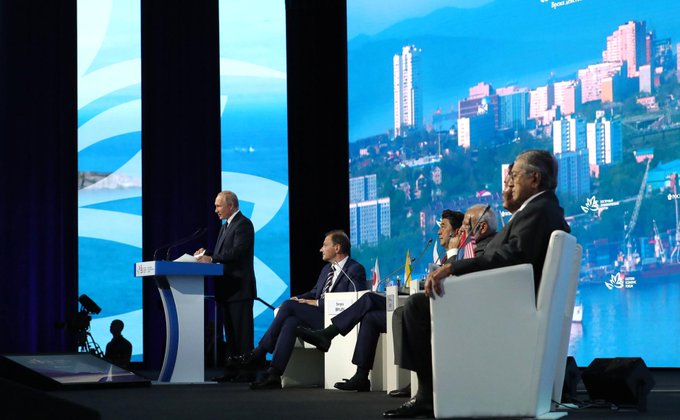
was the declaration by Prime Minister
Giuseppe Conté when he received President Vladimir Putin in Rome. The message
was intended as a tranquilliser, even a sleeping pill, for public opinion.
Fundamentally, the meeting was limited to the state of economic relations.
Russia,
where 500 Italian companies are situated, is the fifth greatest extra-European
market for our exports, and supplies 35 % of Italy's need for natural gas.
These exchanges – specifies Putin – were worth 27 billion dollars in 2018, but
in 2013, they generated 54 billion. This means that they have been halved
because of what Conté calls « the deterioration of relations between
Russia and the European Union which led to European sanctions » (which are
in fact decided in Washington).
Despite
this, there exists between the two countries « an intense relation at all
levels ». A reassuring tone, which echoes that of Conte's visit Moscow in
2018 and Prime Minister Matteo Renzi's trip to Saint Petersbourg in 2016, when
he guaranteed that « the phrase 'Cold War' has exited history and also
reality ». So the farce continues.
In his
relations with Russia, Conté (like Renzi in 2016) presents himself only in the
function of head of government of a
European Union country, dissimulating Italy's membership in NATO, under command
of the USA, which it considers a « privileged ally ». So at the
Italy- Russia table there is a space reserved for the stone guest, the
« privileged ally » with Italy swimming in its wake.
The
Conté government declares that the state of relations with Russia is
« excellent », even though less than a week earlier at NATO
headquarters, he had once again accused Russia of having violated the INF Treaty (on the basis of
« proof » supplied by Washington), thus falling into step with the US
decision to bury the Treaty in order to install new intermediate-range nuclear
missiles pointed at Russia.
On 3
July, the eve of Putin's visit to Italy, Moscow published a law, signed by
Putin, suspending Russian participation in the Treaty, a preventative act
before Washington left definitively on 2 August.
Ø Putin also warned that if the
USA deployed new nuclear weapons in European countries close to Russia, then
Russia would point its missiles at the areas where these missiles are based.
Ø So the warning also affects
Italy, which is presently preparing to house, from 2020, the new B61-12 bombs
which are also available for the Italian Air Force - under US command.
Ø One week before the
confirmation of this « excellent » state of relations with Russia,
the Conte government confirmed Italian
participation in the NATO force – under
US command – of 30 warships, 30 battalions and 30 aerial squadrons which can be
deployed in Europe within 30 days against Russia as from 2020.
Ø Maintaining the anti-Russia
function, Italian ships are taking part in NATO manoeuvres of submarine
warfare. Mechanised Italian forces are part of the NATO battle group in Latvia,
while two weeks ago, the Ariete Armoured Brigade was in training in Poland.
Italian fighter aircraft - Eurofighter Typhoons – are deployed in Romania and
Latvia.
All of
this confirms that Italian foreign and military policy is not decided in Rome,
but in Washington, right under the nose of the «sovereignty»
attributed to the current government.
Relations
with Russia, like those with China, are based on the quicksand of Italian
dependency on the strategic decisions made in Washington. We only have to
remember how in 2014, on orders by Washington, the Russia-Italy South Stream
gas pipeline was sabotaged, causing billions of Euros of loss for Italian
companies. In the absolute silence and consensus of the Italian government.
il manifesto,
09 July 2019
Translation :
Pete Kimberley
ФЛОРЕНТИЙСКАЯ ДЕКЛАРАЦИЯ
ЗА МЕЖДУНАРОДНЫЙ ФРОНТ «НАТОЭКЗИТ»
DANSK DEUTSCH ENGLISH ESPAÑOL FRANÇAIS ITALIANO NEDERLANDS
PORTUGUÊS ROMÎNA SLOVENSKÝ SVENSKA TÜRKÇE РУССКИЙ СРПСКИ
PORTUGUÊS ROMÎNA SLOVENSKÝ SVENSKA TÜRKÇE РУССКИЙ СРПСКИ
Manlio Dinucci
Geographer and geopolitical scientist. Most recent books:: Laboratorio di geografia, Zanichelli 2014 ; Diario di viaggio, Zanichelli 2017 ; L’arte della guerra / Annali della strategia Usa/Nato 1990-2016, Zambon 2016, Guerra Nucleare. Il Giorno Prima 2017; Diario di guerra Asterios Editores 2018.
Author of the documentation presented at the International Conference on the 70th Anniversary of NATO – I 70 ANNI DELLA NATO: DI GUERRA IN GUERRA -- Firenze, April 7, 2019 and together with Prof. Chossudovsky wrote and signed the Declaration of Florence.
Author of the documentation presented at the International Conference on the 70th Anniversary of NATO – I 70 ANNI DELLA NATO: DI GUERRA IN GUERRA -- Firenze, April 7, 2019 and together with Prof. Chossudovsky wrote and signed the Declaration of Florence.
International award for geostrategic analysis awarded on 7 June 2019 by the Club of journalists of Mexico, A.C.